Quick answer: Rugs are produced by four primary techniques: hand-knotting (a knot tied around each warp thread; the heirloom standard), flat-weaving (interlocked weft on a wool warp; produces kilims), tufting (yarn punched through a pre-existing backing), and machine-weaving. A 9×12 hand-knotted rug typically takes nine to twelve months of one weaver’s life — which is the price ceiling.
Rug weaving techniques encompass the fundamental construction methods that transform raw wool, silk, and cotton into functional textiles—knowledge that separates artisan-made pieces from mechanized reproductions and enables informed evaluation of quality, durability, and authenticity. Traditional hand-weaving employs vertical or horizontal looms where weavers interlace warp and weft threads using techniques refined over millennia: pile-knotting methods that create raised surfaces, flatweave techniques producing reversible tapestries, and specialized approaches for borders, fringes, and structural reinforcement. Regional traditions—Turkish, Persian, Central Asian, and Caucasian—each developed distinctive loom types, knotting styles, and finishing methods that reflect cultural heritage, available materials, and intended textile functions. For collectors, designers, and anyone seeking to understand handwoven rug craftsmanship, knowledge of weaving techniques provides essential insight into construction quality, regional attribution, and the labor investment that justifies luxury textile pricing and long-term value.
Loom Types: Vertical, Horizontal & Nomadic Traditions
Vertical looms dominate city workshop and village production, consisting of two horizontal beams (upper and lower) between which warp threads are stretched under tension. Weavers work from bottom to top, knotting pile or weaving flatweave patterns while seated on adjustable benches that rise as work progresses. Vertical looms allow precise tension control and accommodate large carpet dimensions, making them ideal for complex designs requiring consistent knotting density and pattern accuracy. Persian and Turkish city workshops employ sophisticated vertical looms with mechanisms for pattern tracking and warp tension adjustment.
Horizontal ground looms serve nomadic and some village communities, consisting of four stakes driven into earth with warp threads stretched between them at ground level. Weavers work seated or kneeling, moving around the loom perimeter as weaving progresses. Horizontal looms limit carpet size to dimensions that allow weavers to reach the center from edges—typically under 6-8 feet wide—but offer portability essential to nomadic lifestyles. Tribal Kilims, Baluchi rugs, and nomadic pile carpets are traditionally woven on horizontal looms, often outdoors during seasonal migrations.
Roller Beam Looms: Enabling Large-Scale Production
Roller beam looms feature rotating upper and lower beams that wind completed work and release new warp threads, enabling carpet production exceeding loom height. This innovation allows workshop production of room-sized carpets (12x18 feet or larger) on relatively compact looms. As weaving progresses, completed sections roll onto the lower beam while new warp releases from the upper beam, maintaining consistent working height for weavers. Most contemporary city workshop production employs roller beam vertical looms for their efficiency and size flexibility.
Hand-Knotting Techniques: Turkish vs. Persian Knots
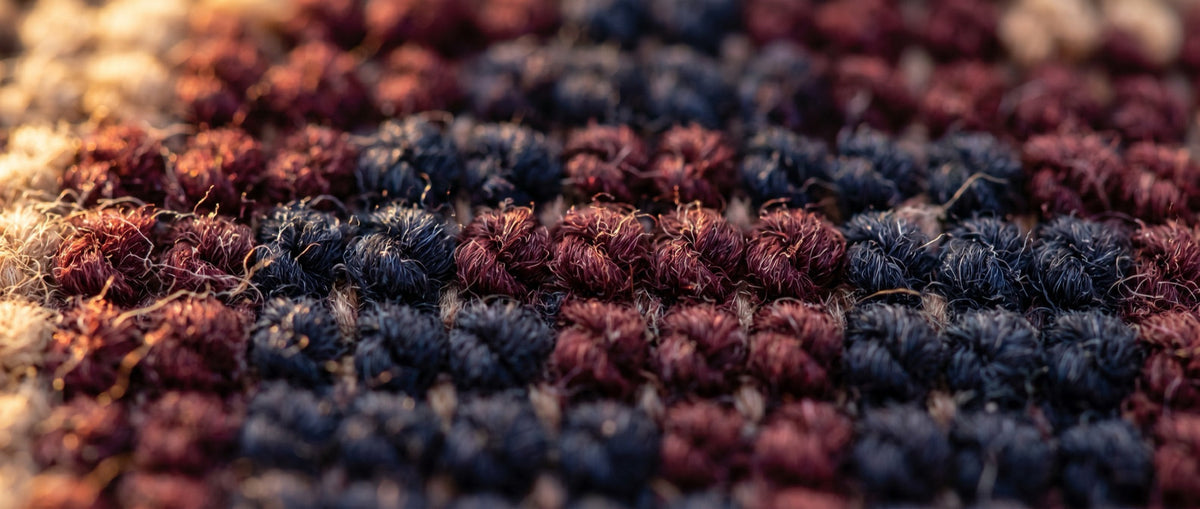
Hand-knotting creates pile rugs by wrapping colored yarn around warp threads, then cutting the yarn to create individual tufts that form the rug surface. Two primary knotting methods dominate traditional production: the symmetrical Turkish (Ghiordes) knot and the asymmetrical Persian (Senneh) knot. Each technique produces distinct structural characteristics and enables different design possibilities.
The Turkish knot wraps yarn around two adjacent warp threads symmetrically, with yarn ends emerging between the warps. This technique creates strong, durable construction suited to geometric patterns and tribal designs. Turkish, Caucasian, and some Central Asian traditions employ symmetrical knotting, which allows bold pattern definition and withstands the structural stress of nomadic use and frequent rolling for transport.
The Persian knot wraps yarn around one warp thread and loops under the adjacent warp before emerging, creating an asymmetrical structure. This technique enables finer detail and more curvilinear designs than symmetrical knotting, making it ideal for the intricate floral compositions characteristic of Persian city carpets. Most Iranian, some Turkish (Hereke, Sivas), and fine Indian rug production employs asymmetrical knotting for its design flexibility and ability to achieve extremely high knot densities.
Knot Density: Measuring Weaving Fineness
Knot density—measured in knots per square inch (KPSI) or knots per square decimeter (KPSD)—indicates weaving fineness and design detail capability. Tribal and village rugs typically range from 40-120 KPSI, city workshop production from 120-300 KPSI, and masterwork carpets from 300-500+ KPSI. Extremely fine knotting (400+ KPSI) allows photographic detail and curvilinear precision but requires years of training and commands premium pricing reflecting the labor investment.
Knot density alone does not determine quality—wool quality, dye depth, design execution, and overall craftsmanship matter equally. Coarsely knotted tribal rugs with excellent wool and natural dyes often surpass finely knotted commercial pieces using inferior materials. Knot density should match design requirements: geometric patterns need less density than intricate florals, and practical durability sometimes benefits from moderate rather than extreme fineness.
Flatweave Techniques: Kilim, Soumak & Dhurrie
Flatweave techniques create pileless textiles by interlacing weft threads over and under warp threads in various patterns. Kilim weaving employs weft-faced construction where colored weft threads completely cover structural warps, creating reversible tapestry-like textiles. Slit-weave Kilims leave small vertical gaps where color blocks meet, while interlocking techniques eliminate slits by wrapping adjacent wefts around shared warps. Turkish, Persian, and Central Asian traditions each developed distinctive Kilim styles with regional color palettes and motif vocabularies.
Soumak weaving creates textured flatweaves by wrapping weft threads around warp threads in figure-eight or herringbone patterns, producing non-reversible textiles with raised surface texture. Caucasian Soumak rugs feature bold geometric designs and exceptional durability, making them popular for high-traffic applications. The technique requires more labor than standard flatweave but produces textiles with greater structural integrity and visual depth.
Dhurrie weaving, traditional to India, employs simple over-under weft interlacing with cotton warps and wefts, creating flat, reversible textiles suited to warm climates. Contemporary dhurries often feature geometric patterns in pastel palettes, offering affordable natural-fiber alternatives to pile rugs for casual interiors.
Warp & Weft Materials: Structural Foundations
Warp threads—the vertical structural elements stretched on looms—determine dimensional stability and tensile strength. Cotton warps dominate contemporary production for their strength, minimal stretch, and ability to maintain consistent tension during weaving. Wool warps appear in tribal and some village production, offering flexibility but less dimensional stability than cotton. Silk warps enable the finest knotting densities, allowing 400+ KPSI in masterwork carpets, but require expert tension control and careful handling.
Weft threads—horizontal elements woven between warp threads after each row of knots—compress pile knots and provide structural integrity. Most rugs employ cotton wefts for strength and consistency, though tribal pieces may use wool, goat hair, or camel hair wefts that add character and flexibility. Weft color and material provide authentication clues: Persian rugs often use blue or red wefts, Turkish rugs favor natural or red wefts, and tribal pieces display varied natural fiber wefts reflecting available materials.
Selvage & Fringe Finishing: Structural Edges
Selvages—the side edges of rugs—receive special reinforcement to prevent unraveling and edge wear. Traditional finishing wraps warp threads with colored wool or cotton, creating decorative and structural edge binding. Selvage quality indicates overall craftsmanship: even, tight wrapping suggests skilled production, while loose or irregular selvages indicate rushed or inexperienced work. Some traditions employ multiple-cord selvages for added durability in high-traffic textiles.
Fringe represents warp thread ends extending beyond the woven textile body. Authentic hand-knotted rugs have fringe as integral structural elements—cutting fringe removes warp threads and compromises rug integrity. Fringe finishing varies by tradition: Persian rugs often feature braided or knotted fringes, Turkish rugs may have simple cut ends or decorative knotting, and tribal pieces display varied finishing reflecting individual weaver preferences. Machine-made rugs typically have sewn-on fringe, a clear indicator of non-handwoven construction.
Regional Weaving Traditions: Technical Signatures
Turkish weaving employs symmetrical knotting, wool or cotton warps, and distinctive red or natural wefts. Anatolian village rugs feature single-weft construction (one weft pass between knot rows), while city workshop pieces use double-weft construction for greater density and stability. Turkish finishing typically includes overcast selvages and simple fringe treatments.
Persian weaving favors asymmetrical knotting, cotton warps and wefts (often dyed blue or red), and double or triple-weft construction. City workshop carpets display extremely even knotting and precise pattern execution, while village and tribal pieces show more irregularity and spontaneous design variation. Persian selvages often feature multiple-cord construction with decorative wrapping.
Caucasian and Central Asian traditions employ symmetrical knotting with wool warps and wefts, creating flexible textiles suited to nomadic use. Tribal pieces display construction irregularities—varying knot density, asymmetrical shapes, spontaneous design changes—that authenticate handcraft production and individual weaver expression rather than workshop standardization.
Contemporary Hand-Weaving: Preserving Traditional Techniques
Contemporary hand-weaving continues in traditional production centers, with artisan cooperatives and family workshops maintaining centuries-old techniques while adapting to current market demands. Quality contemporary production honors traditional loom types, knotting methods, and finishing techniques while offering custom sizing, color modifications, and design variations suited to modern interiors. Reputable producers provide transparency about weaving locations, artisan compensation, and material sourcing—documentation that ensures authentic handcraft rather than mechanized imitations.
Distinguishing hand-woven from machine-made rugs requires examining construction details: hand-knotted pieces show slight irregularities in knotting density and pattern alignment, fringe as integral warp extensions rather than sewn additions, and back surfaces revealing individual knot structure. Machine-made rugs display perfect uniformity, glued or sewn fringe, and backing materials (latex, fabric) that conceal construction rather than revealing it.
Explore our handwoven rug collection, featuring textiles crafted using traditional loom techniques and hand-knotting methods. Our artisan partnerships preserve weaving heritage while ensuring fair compensation and quality materials. Learn about the natural fibers and dyes that define authentic handwoven quality.
Discover rugs woven using centuries-old techniques that honor artisan traditions. Each piece represents authentic hand-knotting, traditional loom construction, and the skilled craftsmanship that creates textiles of enduring beauty and structural integrity.