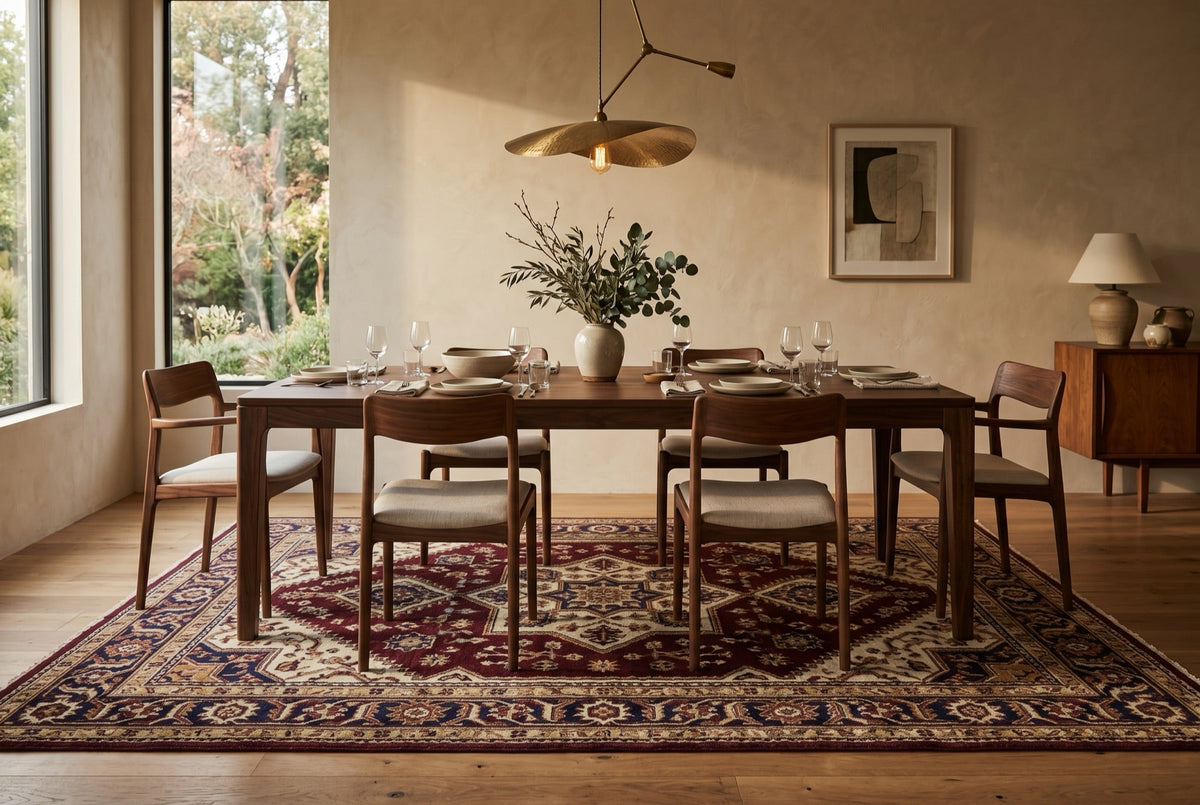
Quick answer: Across the market, a hand-knotted rug costs anywhere from a few hundred dollars for a small piece to $50,000 or more for a rare, finely knotted room-size rug. The price is determined by four variables: size, knot density (KPSI), material (wool grade, silk content, foundation), and provenance (workshop, weaver, age, documentation). At Raihan, prices run from about $200 for a small handwoven kilim to $6,550 for a large hand-knotted Mamluk — see what your budget buys at Raihan today.
Across the market, a hand-knotted rug can cost anywhere from a few hundred dollars to $50,000 or more, and what determines the number is a combination of four variables: size, knot density, material, and provenance. This article walks through what each variable does to the price, gives you a real range for each tier, and explains why a $5,000 piece and a $25,000 piece can look superficially similar but represent two very different things. It is the framework we use when we explain a price to a client — and further down, you will see exactly what your budget buys at Raihan today.
The four variables that determine price
Every hand-knotted rug price comes down to four inputs. Understanding them in isolation lets you read a price tag and know whether it is fair, high, or a steal.
1. Size (the largest single price driver)
A hand-knotted rug is priced essentially by the square foot, but the multiplier per foot varies dramatically with the other three variables. At entry tier (~$25–$50 per square foot), a 6x9 (54 sq ft) sells for $1,400–$2,700 and a 9x12 (108 sq ft) sells for $2,700–$5,400. At master tier (~$200+ per square foot), the same 9x12 starts at $21,600 and goes up from there. Oversize pieces (10x14, 12x18, palace size 13x20+) carry a premium per square foot because the workshop required is larger, the loom rarer, and the weaver pool smaller.
2. Knot density (KPSI)
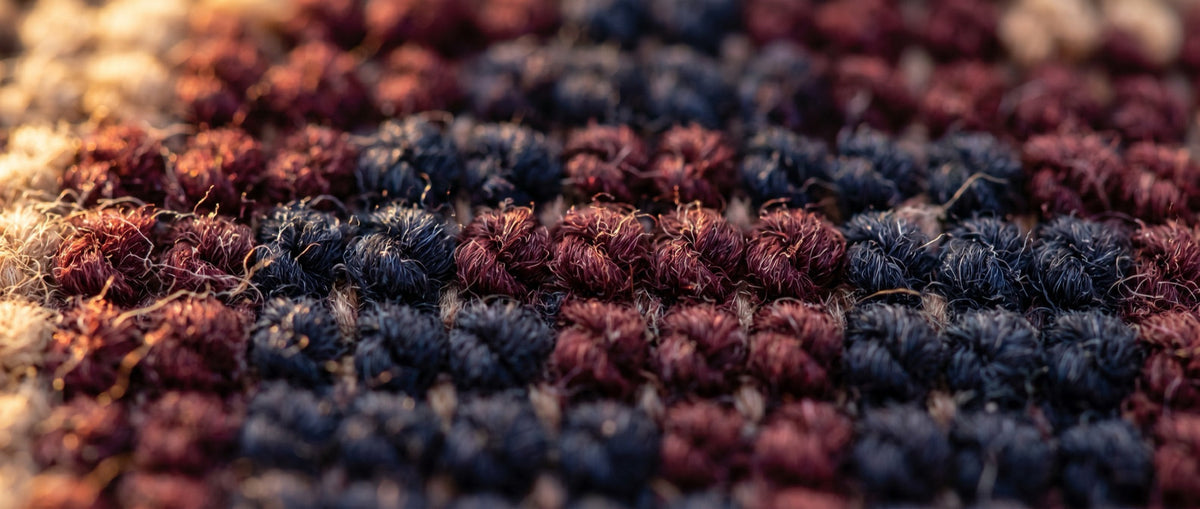
Knot density — measured in knots per square inch — sets the labor floor. A 6x9 rug at 100 KPSI contains roughly 1.3 million knots; at 400 KPSI it contains roughly 5.2 million. At a realistic production pace of 8,000–12,000 knots per weaver per day, that is the difference between four months of labor and sixteen months. The price reflects the labor.
- 60–120 KPSI: tribal / village pieces. Bold geometric work, durable, less detailed. Entry tier.
- 120–250 KPSI: workshop production. Standard for mid-tier Oushak, Heriz, and most contemporary hand-knotted pieces.
- 250–400 KPSI: fine city workshop. Persian Tabriz, Kashan, fine Mamluk revival.
- 400+ KPSI: masterwork. Hereke silk, Isfahan, Qom. Often silk on cotton or silk on silk foundation.
KPSI alone does not determine quality — a coarse-knot tribal piece in great wool and natural dye can outperform a fine-knot commercial piece. But within a tradition, KPSI maps closely to price.
3. Material
The wool grade and foundation type set the material floor on the price.
- Hand-spun Ghazni wool (high lanolin, long staple, hand-spun): top of the wool range. Used in luxury Oushak, Mamluk, fine Afghan production.
- Hand-spun New Zealand wool: common in mid-tier production. Clean, consistent, slightly less character than Ghazni.
- Machine-spun wool: entry tier. Even, predictable, less depth in dye uptake.
- Silk pile: adds 3–10x to the wool baseline depending on percentage and origin (Chinese silk vs Indian silk vs hand-reeled mulberry).
- Cotton foundation: standard for most pieces. Dimensional stability.
- Silk foundation: required for ultra-fine knot densities (400+ KPSI). Roughly doubles foundation cost.
- Vegetable dye: 30–60% premium over synthetic dye at the same wool grade. Aged color depth is the difference.
4. Provenance
Provenance is the documentation that says where the piece was made, by whom, when, and from what materials. A hand-knotted rug with verifiable provenance — workshop attribution, weaver name, dye certification, photographic record on the loom — sells for 20–40% more than the same piece without documentation. Documentation is what makes a $15,000 rug insurable at full replacement value.
Real ranges by tier
Using a 9x12 (108 sq ft) as the reference size:
| Tier | 9x12 price range | Per sq ft | What you are getting |
|---|---|---|---|
| Entry | $2,500 – $5,500 | $25–$50 | Hand-knotted, ~100 KPSI, machine-spun wool, synthetic dye, no provenance docs |
| Mid | $5,500 – $12,000 | $50–$110 | ~200 KPSI, hand-spun wool, vegetable dye, workshop attribution |
| Fine | $12,000 – $25,000 | $110–$230 | 250–400 KPSI, Ghazni wool, full vegetable dye, weaver attribution + provenance docs |
| Master | $25,000 – $80,000+ | $230–$750+ | 400+ KPSI, silk pile or silk-on-silk, master weaver, full documentation, sometimes antique |
What your budget buys at Raihan today
Every figure below comes from our current collection, and each rug is handmade in Afghanistan. Insured U.S. delivery, from $45 and complimentary on rugs $3,500 and up. 14-day home trial · free return pickup.
- Under $700: handwoven flat-weave kilims in accent sizes, small area rugs and runners, from $210. Shop kilims →
- $1,500–$3,000: hand-knotted Mamluks from $1,550, alongside tribal rugs and our larger kilims. Shop Mamluks →
- $3,000+: hand-knotted Oushaks and our largest Mamluks, up to $6,550 — with complimentary delivery from $3,500. Shop Oushaks →
See every rug in the current collection, with prices →
Are hand-knotted rugs worth it?
Yes, if you plan to keep the rug for years. A well-made hand-knotted wool rug is built to last generations with basic care — vacuuming without a beater bar, rotating it, and an occasional professional hand-wash — while a tufted or machine-made rug typically wears out far sooner. Spread over the years you live with it, a hand-knotted rug is often the better value.
We don't sell rugs as investments, and we make no promises about resale value or appreciation. Buy the rug you want to live with, from a seller who can tell you exactly what it is.
What to ask before you buy
- What is the KPSI? (Should be answerable specifically, not "very fine.")
- What is the wool source? (Should name the region, not "the best.")
- What is the foundation material?
- Are the dyes natural or synthetic? (Natural ages gracefully; synthetic does not.)
- Where was it woven and by whom? (Workshop name, weaver name if available.)
- Is there written provenance documentation? (At the fine tier and above, this should exist.)
- What is the return / approval window? (Reputable dealers offer 7–14 days minimum to live with the piece in your space.)
Dealers who cannot answer these specifically are usually selling commercial production at retail markup. Walk away.
Where Raihan fits
Raihan's rugs are made by hand in our weaving workshop in Afghanistan, where we hire women, train women, and pay them directly. Our Mamluk, Oushak and other pile rugs are hand-knotted; our kilims are handwoven flat-weave. Prices run from about $200 for a small kilim to $6,550 for a large Mamluk. Ask us for the knot count of any rug — we'll measure it for you. For background on the materials, see our piece on what defines high-end rug materials. For the broader framework on buying, see our how to buy a hand-knotted rug reference. From our Greater Boston atelier.
Considering a piece in a specific tier? Request a private selection — our Boston curator will reply within 24 hours with three pieces in your budget, sized and palette-matched to your room. A person answers: call or text +1 857 313 9458.