Quick answer: 8x10 fits a small-to-medium living room (under 16x20 ft) where the front legs of the sofa and chairs sit on the rug. 9x12 fits a larger living room (16x20 ft and up) where all furniture sits fully on the rug. The most common mistake is buying 8x10 for a room that needs 9x12 — it makes the rug look like a postage stamp and the room feel cramped.
8x10 and 9x12 are the two most common hand-knotted rug sizes, and the choice between them is the single most consequential decision in any luxury rug purchase. Get it wrong by a foot and the room reads small, the furniture reads detached, and a $20,000 rug looks like a $2,000 rug. This guide walks through when 8x10 works, when 9x12 is essential, and the measurement protocol we use in our Boston atelier when sizing a rug for a client's room.
The rule that decides between 8x10 and 9x12
Measure your living room's interior dimensions, ignoring built-ins. Then apply this rule:
- Room under 14 ft × 17 ft: 8x10 is correct. The rug should leave 18–24 inches of bare floor on each side as a visual border.
- Room 14 ft × 17 ft to 16 ft × 20 ft: 8x10 is borderline; 9x12 is usually better. Check whether 8x10 will allow ALL furniture front legs to land on the rug; if not, go 9x12.
- Room 16 ft × 20 ft and larger: 9x12 is correct. 10x14 or 12x18 may be necessary in palace rooms.
The reason the threshold sits at 14 × 17 is that an 8x10 rug needs at least 2 feet of bare floor border on each side to read intentional rather than accidental. Less than 2 feet of border, and the rug looks like it is reaching for the walls but failing.
The four placement rules
Independent of which size you choose, four placement rules apply:
1. All-on rule (small rooms)
In a small living room with a single seating group, all four legs of every furniture piece sit on the rug. The rug is larger than the furniture footprint by 18–24 inches on each side. This requires either an 8x10 in a tight room or a 9x12 in a standard room.
2. Front-legs-on rule (medium rooms)
Front legs of sofa and chairs sit on the rug; back legs land on bare floor. The rug runs from in front of the sofa to under the coffee table, defining the conversation area. This works with 8x10 in a medium room or 9x12 in a larger room.
3. All-off rule (only for accent rugs)
The rug sits centered between the furniture, all legs on bare floor. This is appropriate only for accent rugs (5x7 or smaller) defining a small zone like a vignette or reading corner. Never use this with an 8x10 or 9x12 — it always reads undersized.
4. Coffee-table containment
The coffee table must always sit fully on the rug, regardless of which placement rule you use for the sofa and chairs. A coffee table half-on, half-off the rug creates a visual fault line that breaks the seating area.
By furniture configuration
| Configuration | Recommended size | Why |
|---|---|---|
| Single sofa + 2 chairs | 8x10 in tight room, 9x12 standard | Front legs of sofa + chairs on rug; coffee table fully on |
| Sectional (small L) | 9x12 minimum | Need 18 in beyond sectional in both directions |
| Sectional (large L or U) | 10x14 or larger | 9x12 will be entirely covered by furniture |
| Two sofas facing | 9x12 minimum, often 10x14 | Front legs of both sofas need to land |
| Bedroom under king bed | 9x12 or 10x14 | 2–3 ft exposed on each side and foot |
| Bedroom under queen bed | 8x10 or 9x12 | Same exposed-border principle |
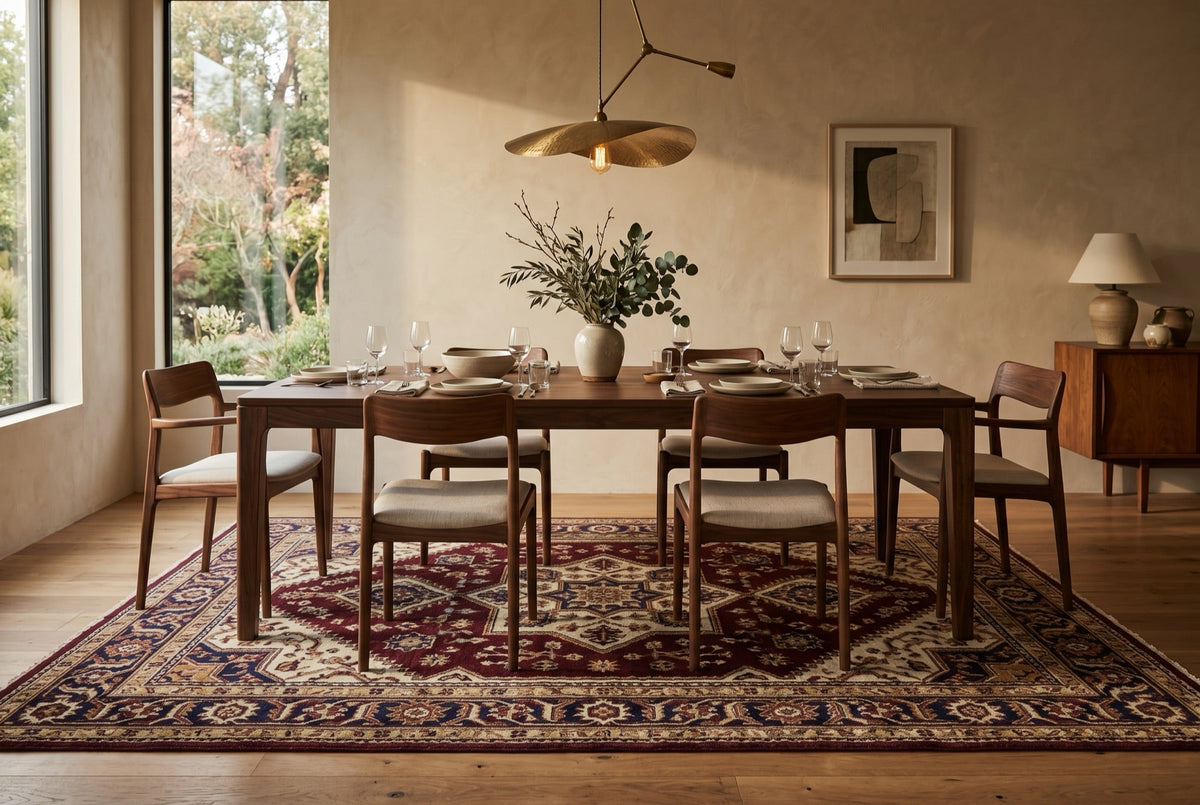
| Dining room with 6-seat table | 8x10 minimum | Chairs must sit on rug when pulled out |
| Dining room with 8-seat table | 9x12 minimum | Same — chair clearance is the constraint |
The measurement protocol
Use this protocol before purchasing:
- Measure the room's interior dimensions in feet, ignoring built-ins. Write down length × width.
- Sketch the furniture in scale (1 ft = 1 inch on graph paper works). Place sofa, chairs, coffee table, side tables.
- Draw the rug at 8x10 in the proposed placement. Check whether the four placement rules are satisfied. If yes, 8x10 is your size.
- If not, draw the rug at 9x12. Re-check. If satisfied, 9x12 is your size.
- If 9x12 still does not satisfy the rules (large room, sectional, or two-sofa configuration), step up to 10x14 or 12x18.
This 10-minute exercise prevents the single most common expensive mistake in luxury rug buying: ordering an undersized piece because "it seemed big enough in the showroom."
The mistakes we see most often
- Buying 8x10 for a 16x20 ft room. Looks small, reads as an island floating in floor.
- Buying 9x12 for a 12x15 ft room. Crowds the walls, removes the visual border that frames the rug.
- Buying 8x10 for a sectional configuration. The sectional covers the rug entirely; the rug functions as padding, not as design.
- Buying without sketching first. Eyeballing the size in a showroom is unreliable. Always sketch.
- Letting the existing furniture dictate too rigidly. If you are buying a $15,000+ heirloom rug and your furniture is rearrangeable, size the rug correctly and rearrange the furniture if needed. The rug will outlast the furniture by decades.
Beyond 9x12: when to go larger
In rooms over 16 × 20 feet (common in Boston Back Bay brownstones, Wellesley center-entry colonials, and most Beacon Hill parlor floors), 9x12 is too small. Step up:
- 10x14: for rooms 17 × 22 ft and similar. Most common up-step in our Boston inventory.
- 12x15: for rooms 18 × 23 ft. Less common but appropriate for square-ish rooms.
- 12x18 or palace size: for parlor floors and great rooms. Often two-piece compositions or oversized single pieces from specialty workshops.
Larger sizes cost more per square foot because the loom is rarer and the weaver pool smaller. Budget accordingly.
Browse by size
Our large-area rug collection covers 9x12 and up. Our living room collection spans 8x10 through 12x18. For dining-specific sizing, see our dining room collection; for bedrooms, the bedroom collection. For the broader buying framework, see our how to buy a hand-knotted rug reference. From our Boston atelier.
Unsure which size your room needs? Request a private selection — send a photo and room dimensions, and our Boston curator will reply within 24 hours with three correctly-sized pieces from current rotation.