Quick answer: Beacon Hill brownstones (built 1810–1860) typically have parlor floors 14–18 ft wide × 22–28 ft long with formal proportions, period millwork, and antique wood floors. The right rug for this context is a 10x14 or 12x18 in a muted, antique-respecting palette (Oushak, soft Persian, antique Heriz, or vintage) with knot density tight enough to hold up to formal entertaining but not so fine that it competes with the architecture.
A Beacon Hill brownstone is a 200-year-old environment with rules. The proportions are formal. The millwork is original. The floors are wide-plank pine or quartersawn oak with decades of patina. The walls are plaster, often with chair rails and crown moldings cast from the original molds. A rug that anchors this kind of room cannot fight the architecture; it has to defer to it. This guide is the framework we use when we curate for the parlor floors, dining rooms, and master bedrooms of Beacon Hill and the surrounding Boston historic neighborhoods.
Why Beacon Hill is its own design context
Most American urban housing stock dates from the post-1920 era. Beacon Hill predates that by a century or more — the neighborhood was built between 1810 and 1860, primarily by Charles Bulfinch, Asher Benjamin, and their architectural successors, in the Federal and Greek Revival styles that defined high-end American urban building of the period.
The defining features that affect rug selection:
- Parlor floor proportions: 14–18 ft wide × 22–28 ft long, with 11–12 ft ceilings, full-width windows facing the street, working fireplaces, and formal entry from a stair hall.
- Period millwork: chair rails, crown moldings, paneled wainscoting, carved mantles. The decorative grammar of the room is already substantial before furniture is added.
- Original or period-faithful floors: wide-plank pine in earlier houses, quartersawn oak in later, often with century-plus patina. The floor color and grain are part of the design vocabulary.
- Restricted alterations: Beacon Hill is a historic district with strict preservation regulations. The room cannot be reconfigured to fit a rug; the rug has to fit the room.
The four selection principles for Beacon Hill rooms
1. Palette: muted, antique-respecting
The wood floors and period millwork already carry significant warm color. A rug that doubles down on warm saturation (e.g., a bright madder-red Tabriz) fights the architecture. A rug with a muted, antique palette — soft saffron, terracotta, ivory, pale blue, sage green, restrained browns — defers to it.
The traditions that work best in this context: Oushak (low contrast, soft palette by default), antique Heriz (geometric but muted with age), antique village Persian with patina, vintage hand-knotted pieces with 30–60 years of color mellowing. The tradition to be more cautious with: bright Kashan or fine Tabriz in jewel tones, which can read aggressive next to original 1830s millwork.
2. Scale: 10x14 minimum, often 12x18
Standard 8x10 and 9x12 rugs are undersized for typical Beacon Hill parlor floors. The room proportions demand 10x14 at minimum and 12x18 commonly. The all-on placement rule (all furniture legs on the rug) is the historically correct approach — anything smaller leaves the rug stranded in the middle of the floor.
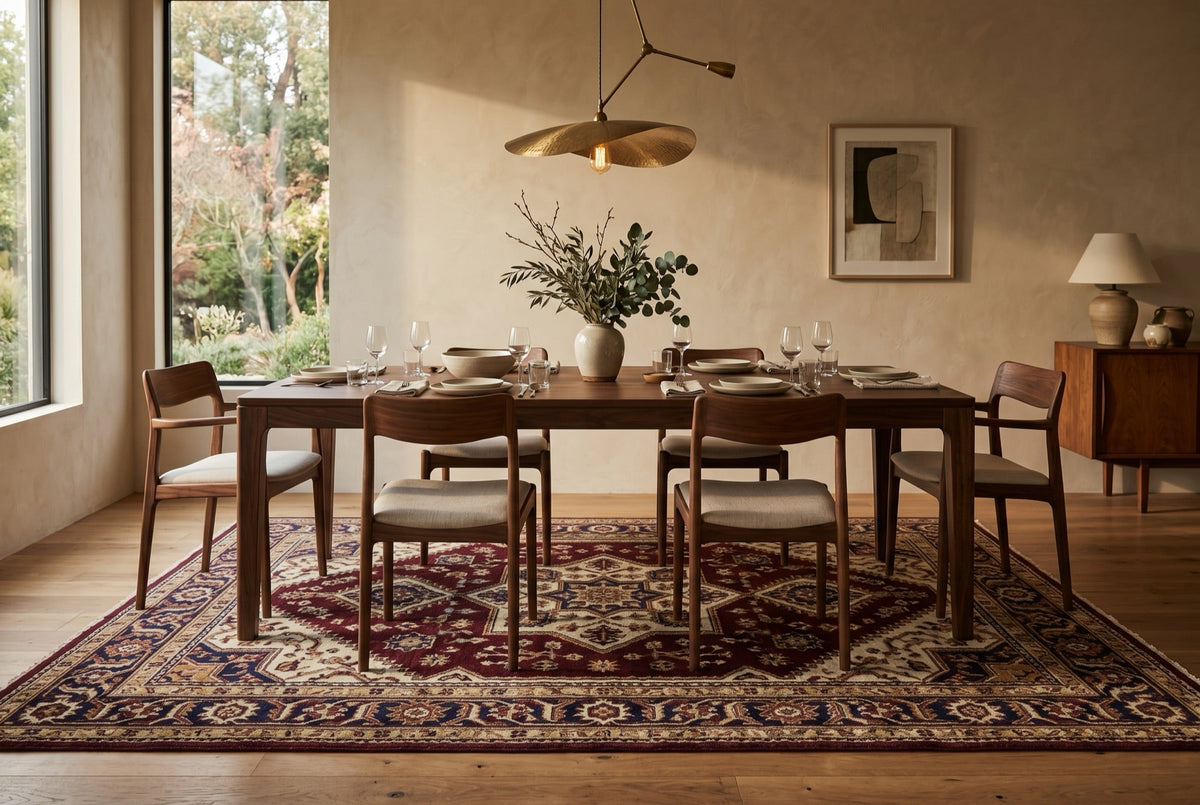
For dining rooms specifically: 9x12 is the absolute minimum for a 6-seater dining table in a Beacon Hill room; 10x14 is correct for an 8-seater; 12x15 is needed for a 10-seater or for a room with sideboard or china cabinet that needs to also sit on the rug.
3. Knot density: traditional, not extreme
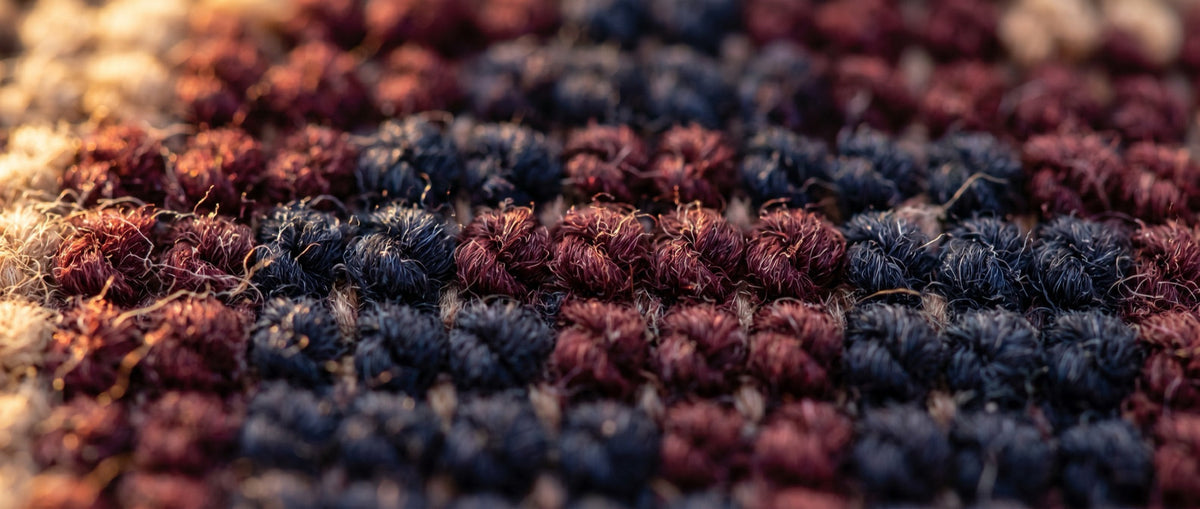
Very fine knot densities (400+ KPSI) produce rugs that read precious — almost too refined for a working room. For Beacon Hill, 150–280 KPSI is the sweet spot: dense enough to hold up to formal entertaining and decades of foot traffic, sophisticated enough to belong in the room, not so fine that it reads as a museum object.
4. Construction: integral fringe, intact pile, hand-spun wool
Period houses look strange with overly-new-looking rugs. The piece should read like it has always belonged in the room — meaning hand-spun wool (which has irregular texture), natural dye (which has color depth), integral fringe (not sewn on), and either genuine age or skilled tea-washing that softens the pile without compromising structural integrity.
Room-by-room guidance
Parlor floor (typical 16 × 24 ft)
10x14 minimum, 12x18 preferred. Place to anchor the seating arrangement around the fireplace. Front legs of both flanking sofas and chairs on the rug. Recommended traditions: Oushak in 12x18 with soft saffron-terracotta-ivory palette; antique Heriz in 11x14 with rust-and-indigo geometric medallion; antique Tabriz in 10x14 with muted curvilinear floral.
Formal dining (typical 14 × 20 ft)
10x14 for 8-seater table; 12x15 for 10-seater. Place centered under the table with sufficient extension on all sides for the chairs to remain on the rug when pulled out. Recommended traditions: muted-palette Oushak, antique Caucasian with disciplined geometric pattern, antique Persian Bijar (durability is essential under a dining table).
Library / study (typical 12 × 16 ft)
8x10 or 9x12 depending on whether the room has a desk-and-chair vignette or a full reading-chair-and-side-table arrangement. The library tolerates more saturated palette and more elaborate motif than the parlor — a fine Tabriz or a richer Heriz is appropriate here. Knot density can step up to 250–350 KPSI without competing with the architecture, because the room itself is already detailed (built-in shelving, paneling).
Master bedroom (typical 15 × 20 ft)
9x12 or 10x14 under the bed, placed so 2–3 ft of rug shows on the foot and both sides. Quieter palette than the parlor; the room is a private space, not a public one, and the rug can lean ivory-ground with soft accent rather than terracotta-ground formality. Vintage Oushak or vintage Persian Nain works well here.
Hallway runners (typical 4 ft × 18–28 ft)
Long Beacon Hill stair halls and second-floor corridors need runners 3 ft wide × the length of the hall. Traditional runner construction: Persian, Caucasian, or vintage Anatolian. The runner should leave 6–10 inches of bare floor on each long side, not extend wall-to-wall.
What to avoid
- Bright synthetic dyes — they read as a 1980s rug, not an heirloom.
- Machine-made tufted "Oriental" rugs — the construction is wrong, the wool is wrong, and the room knows.
- Undersized 8x10 in a 16 × 24 parlor floor — looks like a postage stamp.
- Very fine 400+ KPSI silk pieces on the parlor floor — too precious for the room's function.
- High-contrast modern abstract rugs — these belong in different architectural contexts.
- "Distressed" mass-market overdyed rugs — they fake the patina that Beacon Hill rooms have honestly earned.
Maintenance considerations
Period houses have specific environmental considerations that affect rug care. Plaster walls hold humidity differently than drywall, hardwood floors expand and contract seasonally, and original windows allow more UV penetration than modern double-paned glass. The protocol:
- Rotate the rug 180° annually to balance light exposure
- Professional hand-washing every 5–7 years (more frequently for high-traffic dining rooms)
- Use a high-quality rug pad to absorb the seasonal floor movement and prevent slippage on aged hardwood
- Window UV film on south-facing windows for any room where a rug is permanently placed
Browse pieces suited to Beacon Hill
Our Oushak collection and antique collection are where Beacon Hill buyers tend to start. Our large-area rug collection (9x12 and up) and Boston luxury rugs collection are sized for Boston historic-district rooms. For care guidance, see our care and preservation reference. For neighborhood-specific contact, see our Boston atelier page.
Designing for a Beacon Hill brownstone? Request a private selection — send room dimensions and photos, and our Boston curator will reply within 24 hours with three pieces sized and palette-matched to your specific room.