Quick answer: In handwoven textile language, “rug” generally means a piece under 40 square feet and “carpet” means anything larger — but the more meaningful distinction is the weaving method (hand-knotted, flat-woven, or tufted) and the foundation material (wool, silk, or cotton). Method and material determine durability, drape, and value far more than size.
The terms carpet and rug are often used interchangeably in contemporary design discourse, yet they represent distinct textile categories with different construction methods, historical contexts, and functional applications. In traditional usage, carpets refer to large-scale floor coverings—often room-sized or wall-to-wall—woven as permanent or semi-permanent interior elements, while rugs denote smaller, movable textiles that define specific zones within larger spaces. Handwoven carpets, particularly those from Persian, Turkish, and Central Asian traditions, represent the pinnacle of textile artistry: months of skilled labor, natural materials, and design sophistication that elevate these pieces beyond mere floor coverings into functional art and cultural artifacts. Understanding carpet construction fundamentals, regional weaving traditions, material characteristics, and the distinctions between carpets and rugs provides essential knowledge for collectors, designers, and homeowners seeking to integrate fine handwoven textiles into refined interiors with both aesthetic authority and practical intelligence.
Defining Carpets: Historical Context & Contemporary Usage
Historically, the term carpet derives from the Latin carpita, referring to thick woolen cloth, and came to denote substantial floor coverings that anchored residential and ceremonial spaces. In European usage from the Renaissance through the 19th century, carpets specifically meant large, valuable textiles—often imported from Persia, Turkey, or the Caucasus—that signified wealth and cultural sophistication. These pieces appeared in paintings as status symbols, draped over tables and furniture as much as placed on floors, reflecting their value as decorative and functional objects.
Contemporary usage blurs historical distinctions: in American English, carpet often refers to wall-to-wall synthetic floor covering installed permanently, while rug denotes movable textile floor coverings regardless of size. In European and Middle Eastern contexts, carpet retains its traditional meaning as a substantial, often hand-knotted textile of significant size and value. For purposes of discussing handwoven textiles from traditional weaving cultures, carpet appropriately describes room-sized or larger pieces (typically 8x10 feet and above) that serve as primary floor coverings and design anchors.
Handwoven Carpet Construction: Pile-Knotting Fundamentals
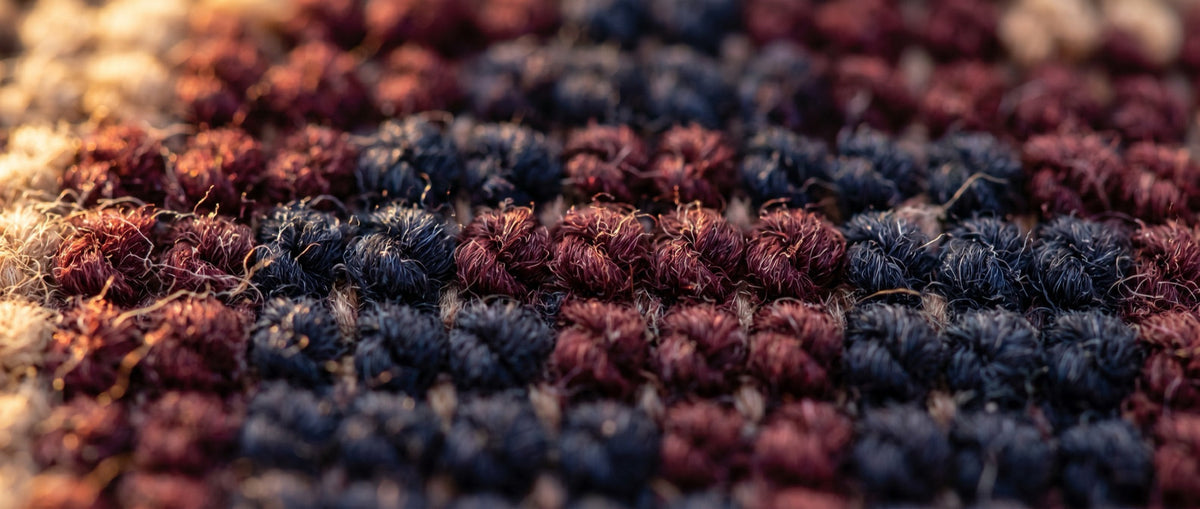
Handwoven carpets employ pile-knotting techniques where individual yarn segments are tied around warp threads, then cut to create the raised surface that defines carpet texture and appearance. Two primary knotting methods dominate traditional production: the symmetrical Turkish (Ghiordes) knot used in Turkish, Caucasian, and some Central Asian traditions, and the asymmetrical Persian (Senneh) knot favored in Iranian and some Turkish city workshops. Each technique produces distinct structural characteristics—Turkish knotting creates durable, bold geometric designs, while Persian knotting enables finer detail and curvilinear compositions.
Knot density, measured in knots per square inch (KPSI), indicates weaving fineness and design detail capability. Village and tribal carpets typically range from 60-150 KPSI, city workshop production from 150-300 KPSI, and masterwork pieces from 300-500+ KPSI. A room-sized carpet at 200 KPSI contains over 2.8 million individual hand-tied knots—labor requiring 6-12 months of skilled work. This extraordinary time and skill investment distinguishes handwoven carpets from machine-made alternatives and justifies the significant pricing that quality examples command.
Persian Carpets: The Gold Standard of Weaving Excellence
Persian carpets represent the most renowned and valuable category in handwoven textile production, with weaving traditions dating to ancient Persia and reaching artistic zenith during the Safavid dynasty (1501-1736). Regional centers—Tabriz, Isfahan, Kashan, Qum, Kerman—each developed distinctive design vocabularies, technical approaches, and quality standards that define Persian carpet aesthetics. Isfahan carpets exemplify refinement with extraordinarily fine knotting (300-500+ KPSI), silk foundations, and classical medallion compositions. Tabriz production balances fineness with durability, while Kashan carpets offer traditional floral designs in rich, saturated colors.
Persian carpet quality derives from material excellence: hand-spun Kork wool from sheep shoulders, natural vegetable dyes producing complex color depth, and silk accents adding luminosity to premium examples. The asymmetrical Persian knot enables the intricate floral compositions, arabesque borders, and curvilinear motifs that distinguish Persian aesthetics from geometric Turkish traditions. Contemporary Persian carpet production continues in traditional centers, maintaining centuries-old techniques while adapting to current market demands for custom sizing and color variations.
Turkish Carpets: Anatolian Weaving Heritage
Turkish carpets from Anatolia encompass diverse regional traditions—Oushak, Hereke, Kayseri, Sivas—each with distinctive characteristics reflecting local materials, design preferences, and weaving techniques. Oushak carpets, originating in western Turkey, feature supple wool, muted vegetable-dyed palettes, and spacious geometric or floral compositions that integrate seamlessly into both traditional and contemporary interiors. The characteristic terracotta, saffron, and soft blue tones create harmonious, low-contrast aesthetics prized by designers and collectors.
Hereke represents Turkey's finest weaving tradition, producing silk carpets with extraordinary knot densities (400-1000+ KPSI) rivaling the best Persian production. Originally established as an Ottoman court workshop in the 19th century, Hereke continues producing masterwork carpets featuring classical Ottoman designs, natural dyes, and technical excellence that commands premium pricing. Turkish carpets generally employ symmetrical knotting and favor geometric design vocabularies, though city workshops like Hereke and Sivas produce curvilinear compositions influenced by Persian aesthetics.
Oriental Carpets: Broader Geographic Traditions
The term Oriental carpet encompasses handwoven textiles from the broader Middle East, Central Asia, and North Africa—including Persian and Turkish production but extending to Caucasian, Turkmen, Afghan, and Moroccan traditions. Each region developed distinctive design languages, color palettes, and technical approaches reflecting cultural heritage and available materials. Caucasian carpets from Azerbaijan, Armenia, and Dagestan display bold geometric patterns, jewel-tone colors, and tribal motifs that differ markedly from Persian refinement or Turkish spaciousness.
Central Asian carpets—particularly Turkmen production—feature distinctive gul motifs (octagonal medallions), deep red grounds derived from madder and iron mordants, and fine wool from hardy sheep breeds adapted to harsh climates. Afghan carpets continue tribal weaving traditions with geometric precision and saturated colors, while Moroccan Berber carpets offer minimalist geometric compositions in natural wool tones. Understanding these regional distinctions enables informed collecting and ensures appropriate attribution and valuation.
Carpet vs. Rug: Functional & Design Distinctions
Beyond size differences, carpets and rugs serve distinct functional and design roles in interior composition. Carpets function as foundational elements that define entire rooms, establish color palettes, and anchor furniture arrangements—their substantial size and visual presence make them primary design decisions around which other elements organize. Room-sized carpets (8x10 to 12x18 feet) suit living rooms, dining areas, and master bedrooms where comprehensive floor coverage and spatial definition are desired.
Rugs, particularly smaller area rugs and accent pieces (4x6 to 6x9 feet), serve more targeted functions: defining conversation zones within larger spaces, adding pattern and color to neutral interiors, or introducing material warmth to specific areas. Runners (2.5-4 feet wide, various lengths) guide circulation through hallways and define transitional spaces. This functional distinction affects selection criteria—carpets require consideration of room proportions and furniture scale, while rugs offer flexibility for layering, seasonal rotation, and design experimentation.
Material Excellence: What Defines Quality Carpets
Quality handwoven carpets begin with superior materials: hand-spun wool retaining natural lanolin and crimp, vegetable dyes producing complex color depth, and cotton or silk foundations providing structural integrity. The finest wool—highland varieties from sheep in harsh climates—develops long, resilient fibers with natural luster and soil resistance. Hand-spinning preserves fiber alignment and introduces slight irregularities that create visual depth and authenticate artisan production.
Natural dyes—madder root for reds, indigo for blues, weld for yellows—produce the layered, multi-tonal colors that distinguish fine handwoven carpets from commercial alternatives. Vegetable dyes age gracefully, mellowing into harmonious palettes over decades rather than fading harshly like synthetic colorants. Dye quality assessment requires examining color depth, tonal variation, and the presence of abrash (natural color shifts within dye lots) that authenticates traditional production methods.
Foundation materials affect durability and dimensional stability: cotton warps and wefts provide strength and minimal stretch, maintaining carpet shape over decades of use. Silk foundations enable the finest knotting densities (400+ KPSI) in masterwork pieces but require expert handling and climate control. Wool foundations appear in tribal and some village production, offering flexibility but less dimensional stability than cotton.
Carpet Sizing: Selecting Appropriate Dimensions
Proper carpet sizing requires understanding room dimensions, furniture scale, and spatial proportions. Living room carpets should accommodate all front furniture legs (sofas, chairs) on the carpet surface, with 18-24 inches extending beyond furniture perimeters. For typical living rooms (14x18 feet), 9x12 or 10x14 carpets provide appropriate scale, while larger spaces (16x20+ feet) require 12x15 or larger to maintain visual proportion.
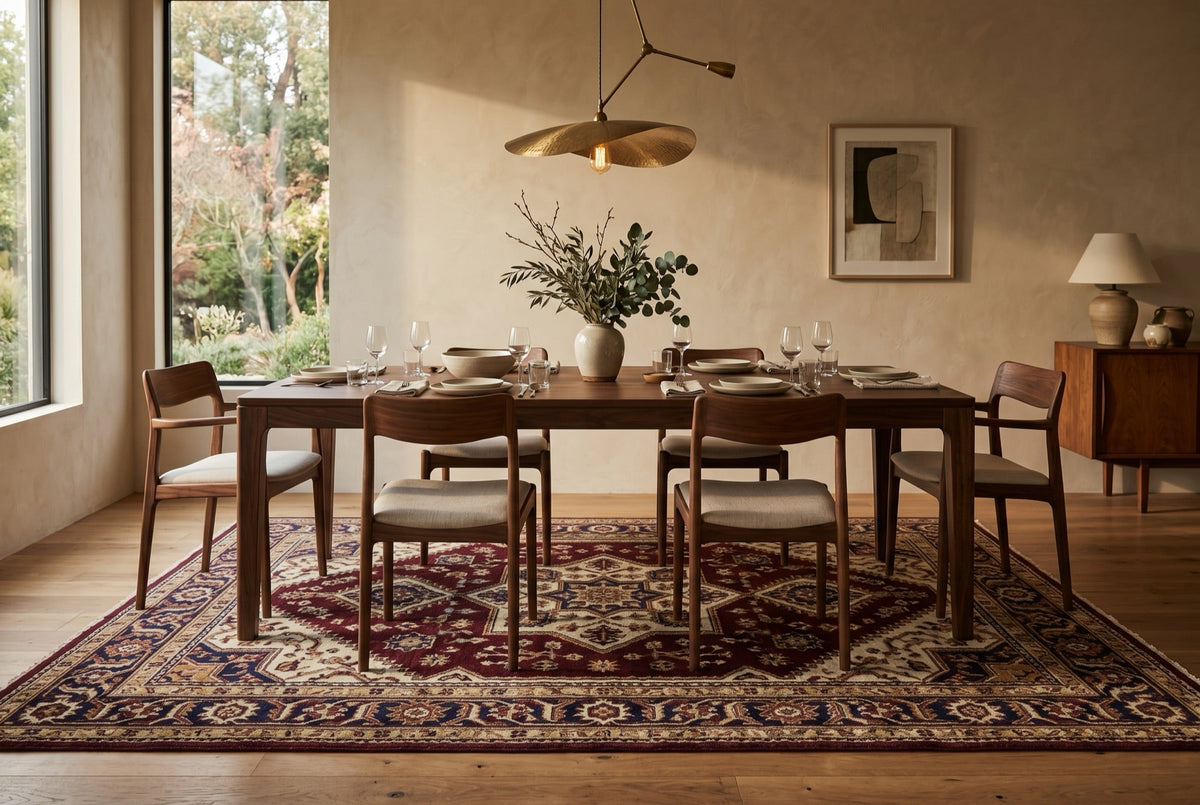
Dining room carpets must extend 24-36 inches beyond table edges on all sides, ensuring chairs remain on carpet when pulled out for seating. A 6-foot dining table requires at least an 8x10 carpet, while 8-foot tables need 9x12 or larger. Bedroom carpets can be positioned under the lower two-thirds of beds with perimeter exposure, or placed entirely under beds with substantial borders visible—each approach creates different spatial effects and requires different dimensions.
Carpet Care & Preservation
Handwoven carpets require specialized care that differs from synthetic wall-to-wall carpet maintenance. Vacuum regularly using suction-only attachments without beater bars, which can damage hand-knotted construction. Vacuum in the direction of pile, never against it, and reduce suction for antique or fragile textiles. Rotate carpets every 6-12 months to ensure even wear and light exposure, preventing directional pile crushing and color fading.
Professional cleaning every 3-5 years maintains appearance and extends carpet life. Seek specialists trained in hand-washing techniques using pH-neutral, wool-safe detergents and controlled drying environments—avoid general carpet cleaning services using hot water extraction or chemical treatments designed for synthetic materials. For spills, blot immediately with clean white cloths, never rub. Avoid household cleaners, which can alter vegetable dye chemistry and cause irreversible damage.
Proper rug pads cushion foot traffic, prevent slippage, and allow air circulation that prevents mold growth. Choose natural rubber or felt pads sized slightly smaller than carpet perimeters. Avoid placing valuable handwoven carpets in high-moisture areas (bathrooms, kitchens, entryways exposed to weather) where constant moisture exposure degrades natural fibers and promotes deterioration.
Contemporary Carpet Design: Tradition Meets Modern Aesthetics
Contemporary carpet production balances traditional techniques with current design preferences. Modern interpretations maintain hand-knotting methods and natural materials while offering custom colors, simplified patterns, and scales suited to minimalist interiors. Some workshops produce traditional designs in non-traditional colorways—Oushak patterns in grays and ivories rather than terracotta and blues—creating pieces that honor weaving heritage while aligning with contemporary aesthetics.
Overdyed carpets represent another contemporary approach: vintage pieces receive additional dye applications that saturate original colors with bold, modern hues. This process revitalizes faded textiles while creating unique design statements that bridge traditional construction and contemporary color sensibilities. Quality overdying respects carpet integrity, enhancing rather than concealing original craftsmanship.
Explore our handwoven carpet collection, featuring Persian-design and Oushak-style carpets in room-sized dimensions, woven at our workshop in Afghanistan. Our artisan partnerships ensure traditional construction methods and natural materials. Contact our design consultation services for guidance on selecting carpets suited to your interior dimensions and aesthetic preferences.
Discover handwoven carpets that represent centuries of weaving mastery. Each piece embodies traditional construction, natural materials, and design heritage that anchors refined interiors with enduring beauty and lasting quality.