Handwoven rugs occupy a unique position in interior design—simultaneously functional floor coverings and artisan-crafted textiles worthy of museum display. Unlike purely decorative objects that serve no practical purpose or utilitarian furnishings lacking aesthetic distinction, quality rugs bridge function and art through material excellence, design sophistication, and the cultural narratives embedded in traditional weaving techniques. In refined interiors, rugs function as foundational design elements that establish spatial hierarchy, introduce material warmth, and provide the textural complexity essential to sophisticated composition. Understanding how to select and integrate handwoven textiles as functional art requires knowledge of proportion, material characteristics, color theory, and the spatial dynamics that distinguish curated environments from merely furnished rooms. This guide explores the principles governing rug selection and placement in luxury interiors, examining how Persian, Turkish, and tribal textiles transform spaces through their dual nature as practical floor coverings and artisan masterworks that anchor refined residential design.
Rugs as Functional Art: Bridging Utility and Aesthetic Excellence
The concept of functional art—objects serving practical purposes while exhibiting artistic merit—finds perfect expression in handwoven rugs. A Persian Tabriz or Turkish Oushak provides essential floor protection, acoustic dampening, and thermal insulation while simultaneously offering the visual complexity, material authenticity, and cultural significance that define art objects. This duality distinguishes quality handwoven textiles from both purely decorative wall art and purely functional synthetic floor coverings, creating a category where utility enhances rather than diminishes artistic value.
Handwoven rugs achieve functional art status through several characteristics: months of skilled artisan labor creating each piece, natural materials aging gracefully rather than degrading, traditional designs carrying cultural and historical significance, and construction quality ensuring decades or centuries of use. Unlike paintings or sculptures that require protective display conditions, rugs fulfill their artistic potential through daily interaction—foot traffic, furniture placement, natural light exposure—that reveals material qualities and design sophistication impossible to appreciate in static museum contexts.
In luxury interior design, this functional art status elevates rugs from decorative accessories to foundational elements around which entire rooms organize. Furniture selection, color palettes, lighting design, and architectural finishes respond to rug characteristics rather than treating textiles as afterthoughts applied to completed spaces. This approach recognizes that rugs occupy the largest single surface area in most rooms and therefore exert disproportionate influence on spatial perception and aesthetic character.
Material Integrity: Why Natural Fibers Define Functional Art Quality
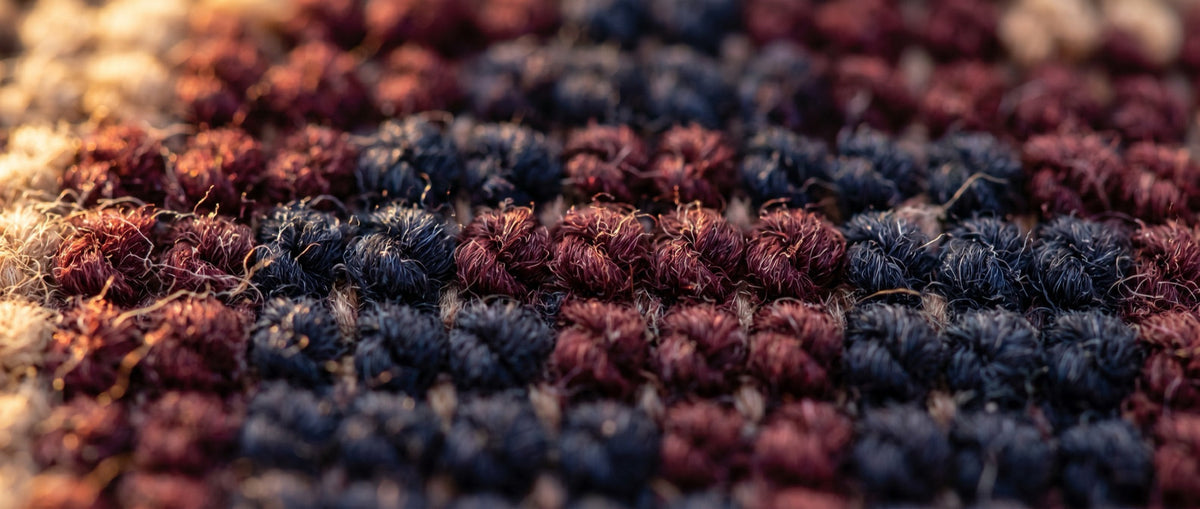
Material authenticity separates functional art from commercial floor coverings. Handwoven rugs employing natural wool, silk, and cotton fibers with vegetable dyes offer tactile richness, visual depth, and aging characteristics that synthetic materials cannot replicate. Hand-spun wool retains natural crimp and irregularity that creates dimensional texture, while natural lanolin provides inherent soil resistance and the soft luster characteristic of quality textiles. These material qualities prove essential to both functional performance—durability, comfort, maintenance—and artistic merit through organic beauty and authentic craftsmanship.
Vegetable dyes produce the complex, multi-tonal colors that distinguish fine handwoven rugs from commercial alternatives. Madder root creates reds with depth and variation impossible in synthetic colorants, indigo produces blues that shift with lighting conditions, and natural yellows from weld and saffron mellow into harmonious tones over decades. This color complexity functions artistically by providing visual interest that rewards sustained viewing, while serving practically by aging gracefully rather than fading harshly like synthetic dyes.
Explore our handwoven rug collection featuring natural wool and silk textiles with vegetable dyes that exemplify functional art quality through material authenticity and traditional construction methods.
Spatial Composition: Rugs as Architectural Foundations
In refined interior design, rugs function as architectural elements that establish spatial hierarchy, define functional zones, and create visual relationships between furniture, walls, and ceiling planes. Proper rug placement transforms undifferentiated floor area into organized composition where each element relates intentionally to others. This architectural function proves particularly critical in open-plan interiors where traditional walls no longer define room boundaries—rugs create spatial definition through material contrast, pattern delineation, and the psychological boundaries that textiles establish.
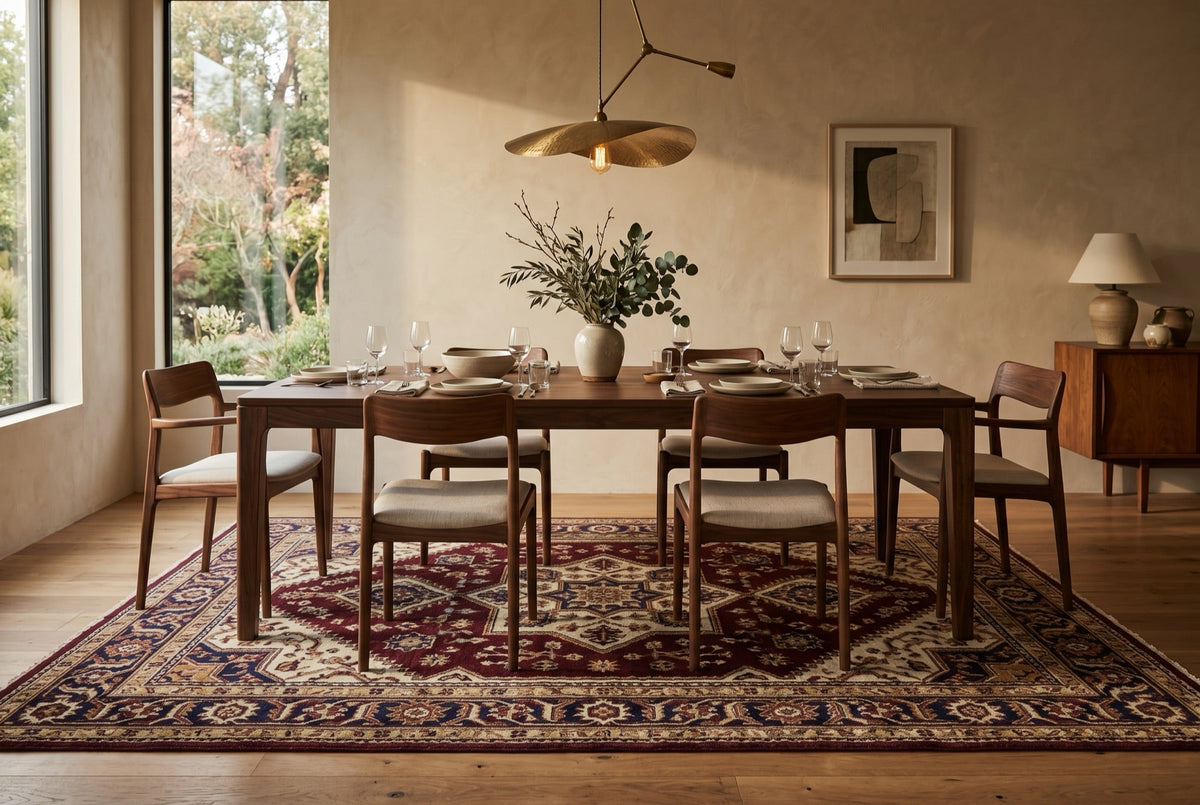
Scale relationships determine whether rugs successfully anchor spaces or appear visually adrift. Living room rugs should accommodate all front furniture legs—sofas, chairs, ottomans—on the textile surface, with 18-24 inches extending beyond furniture perimeters. This sizing unifies seating groups and prevents the floating appearance that occurs when rugs are undersized relative to furniture scale. Dining room rugs require dimensions extending 24-36 inches beyond table edges, ensuring chairs remain on textile surfaces when pulled out and preventing the visual disruption of furniture straddling rug boundaries.
Bedroom applications offer flexibility: rugs positioned under the lower two-thirds of beds with perimeter exposure create visual anchoring while maintaining hard floor visibility, while rugs placed entirely under beds with substantial borders provide comprehensive material warmth. Each approach creates different spatial effects—partial coverage emphasizes bed as focal point, full coverage establishes textile as primary design element. Understanding these spatial dynamics enables intentional design decisions rather than arbitrary placement based on available rug dimensions.
Color Theory: Rugs as Palette Foundations
In sophisticated interiors, rugs establish color narratives that furniture, wall finishes, and accessories support rather than compete with. This approach inverts conventional decorating sequences where walls receive color first and textiles adapt to existing palettes. Beginning with rug selection allows designers to build harmonious compositions around the complex, multi-tonal colors that quality handwoven textiles provide—colors impossible to replicate in paint or fabric but essential to creating depth and visual interest.
Neutral rugs in ivory, taupe, and soft grays function as architectural foundations that allow furniture and art to remain focal points. These pieces provide material warmth and textural interest without color commitment, suiting interiors where flexibility and restraint take priority. Earth-toned rugs featuring terracotta, ochre, and warm browns introduce organic color that connects interiors to natural materials—wood, stone, leather—creating cohesive compositions grounded in material authenticity rather than arbitrary color choices.
Saturated colors—deep blues, rich reds, jewel tones—demand careful integration but reward bold use with dramatic impact. Persian rugs with crimson grounds and navy borders, Turkish pieces with indigo fields and terracotta accents, or tribal textiles with saturated geometric patterns create strong visual anchors that organize entire rooms around their color relationships. Success requires restraint elsewhere: neutral walls, simple furniture upholstery, and minimal pattern competition allow colorful rugs to command attention without creating visual chaos.
Abrash—the natural color variation within dye lots characteristic of vegetable-dyed textiles—provides visual texture that prevents the flat appearance of uniform colors. This subtle tonal shifting adds depth and authenticates handcraft production while creating color complexity that integrates varied lighting conditions. Morning daylight, afternoon sun, and evening artificial light each reveal different aspects of abrash, making rugs appear dynamic rather than static—a quality essential to functional art that rewards daily interaction.
Pattern and Design: Visual Complexity in Functional Contexts
Pattern selection affects both aesthetic impact and practical performance. Intricate Persian florals with polychrome palettes provide maximum visual interest but require careful integration to avoid overwhelming spaces. These designs suit formal living rooms, libraries, and dining areas where visual sophistication takes priority and furniture arrangements remain relatively stable. Spacious Oushak compositions with generous negative space and muted palettes integrate more easily into varied contexts, functioning as neutral foundations despite containing pattern—their visual restraint allows furniture and architectural elements to remain prominent.
Geometric patterns—particularly those from Kilim flatweave and tribal traditions—offer graphic impact with contemporary appeal. Angular motifs, repeating diamonds, and stylized tribal symbols create bold visual statements that align with minimalist and transitional aesthetics. These patterns prove particularly effective in open-plan spaces where strong graphic elements help define zones and create visual interest across large, undifferentiated floor areas.
Pattern scale must relate to room dimensions and viewing distances. Large rooms accommodate oversized medallions and bold geometric patterns that would overwhelm compact spaces, while smaller areas require finer, more intricate designs that maintain visual interest without dominating. Directional patterns—runners with linear motifs, rugs with clear orientation—should align with room geometry and furniture arrangement to reinforce spatial flow rather than create visual confusion.
Texture and Pile: Tactile Dimensions of Functional Art
Texture introduces dimensional depth that color and pattern alone cannot achieve. Pile height variations create relief patterns through carved or sculpted surfaces, mixed-technique textiles combine knotted and flatweave construction for textural contrast, and inherent material characteristics—wool crimp, silk luster, natural fiber irregularity—provide tactile richness that engages touch as much as vision. This multisensory quality distinguishes functional art from purely visual artwork, creating objects that reward physical interaction through daily use.
Low-pile rugs (under 0.5 inches) offer subtle texture with maximum practicality, suited to high-traffic areas and spaces requiring easy furniture movement. Medium-pile rugs (0.5-0.75 inches) balance comfort and durability for most residential applications, providing cushioning underfoot while maintaining pattern clarity and ease of maintenance. High-pile and shag rugs (1+ inches) maximize softness but complicate cleaning and show traffic patterns—reserve these for low-traffic bedrooms and sitting areas where comfort outweighs practical concerns.
Flatweave Kilims provide thin profiles ideal for layering, under dining tables, and in spaces where visual weight must remain minimal. The reversible nature of quality flatweaves extends usable life and offers design flexibility unavailable with pile construction. Textural contrast between flatweave and pile rugs enables layering strategies that create dimensional complexity—smaller Kilims over larger pile rugs, animal hides atop handwoven textiles—adding visual interest and seasonal adaptability to refined interiors.
Defining Space in Open-Plan Interiors
Open-plan living areas benefit profoundly from strategic rug placement that creates functional zones without architectural walls. Multiple rugs define distinct areas—living, dining, workspace—within continuous floor planes, establishing psychological boundaries that organize activities and furniture groupings. Successful multi-rug layouts require coordinating colors, patterns, and styles to create visual cohesion without exact matching. Common approaches include using rugs from the same design family in different sizes, employing consistent color palettes across varied patterns, or anchoring primary seating with statement pieces while supporting zones receive simpler, complementary textiles.
Spatial separation between adjacent rugs matters as much as individual rug placement. Maintain 18-36 inches of exposed floor between rugs to clearly delineate zones and prevent visual congestion. This negative space allows each rug to function as distinct spatial anchor while contributing to overall interior composition. The exposed floor creates visual breathing room essential to luxury aesthetics, where restraint and proportion matter as much as the objects themselves.
Rug orientation reinforces or contradicts spatial flow: rugs aligned with room geometry and furniture arrangement create harmonious compositions, while perpendicular or diagonal placements introduce dynamic tension. In most residential contexts, alignment proves preferable—it reinforces architectural logic and creates the visual calm characteristic of refined interiors. Reserve unconventional orientations for spaces intentionally seeking energy and visual disruption rather than repose.
Acoustic and Thermal Performance: Functional Benefits Beyond Aesthetics
Handwoven rugs provide acoustic dampening particularly valuable in contemporary interiors dominated by hard surfaces—polished concrete, stone, glass, hardwood. Wool fibers absorb sound frequencies that reflect off smooth materials, reducing echo and creating more comfortable acoustic environments. This functional benefit proves especially important in open-plan spaces where sound travels freely between zones, and in rooms with high ceilings where reverberation can create uncomfortable noise levels.
Thermal insulation adds comfort and energy efficiency: rugs create barrier layers between feet and cold floors, making spaces feel warmer without raising thermostats. This proves particularly valuable over concrete slabs, stone floors, and in older homes with poor subfloor insulation. The insulating effect varies with pile height and fiber density—thicker, denser rugs provide greater thermal resistance—but even thin flatweaves offer measurable improvement over bare hard surfaces.
These functional benefits reinforce the concept of rugs as practical art: they improve living comfort and building performance while delivering aesthetic sophistication. This multifunctionality justifies the price of quality handwoven textiles in a way purely decorative objects cannot match.
Care and Preservation: Maintaining Functional Art Over Decades
Proper maintenance preserves both functional performance and artistic value. Vacuum regularly using suction-only attachments without beater bars, which can damage hand-knotted construction. Vacuum in the direction of pile, never against it, and reduce suction for antique or delicate textiles. Rotate rugs every 6-12 months to ensure even wear and light exposure, preventing directional pile crushing and color fading in high-traffic areas or near windows.
Professional cleaning every 3-5 years removes embedded dirt that accelerates fiber wear and maintains appearance. Seek specialists trained in hand-washing techniques using pH-neutral, wool-safe detergents and controlled drying environments—avoid general carpet cleaning services using hot water extraction or chemical treatments designed for synthetic materials. For spills, blot immediately with clean white cloths, never rub. Avoid household cleaners, which can alter vegetable dye chemistry and cause irreversible damage.
Quality rug pads cushion foot traffic, prevent slippage, and allow air circulation beneath rugs. Choose natural rubber or felt pads sized slightly smaller than rug perimeters to remain invisible while providing full support. Proper padding extends textile life by reducing foundation stress and preventing the abrasion that occurs when rugs shift during use. This simple precaution protects both the functional utility and artistic value that quality handwoven textiles represent.
Learn more about our artisan partnerships and the traditional techniques that create rugs worthy of functional art status through material excellence and construction quality.
Why Handwoven Rugs Transcend Design Trends
Design trends cycle through decades, but handwoven textile quality remains constant. Material excellence, artisan craftsmanship, and cultural authenticity prove immune to temporary aesthetic preferences—their value derives from intrinsic characteristics rather than alignment with current color palettes or pattern trends. This permanence makes handwoven rugs sound long-term design choices that improve interiors across ownership periods and style evolutions.
The functional art concept explains this trend immunity: objects serving essential practical purposes while exhibiting artistic merit remain relevant regardless of decorative fashion. A quality Persian rug provides floor protection, acoustic dampening, and thermal insulation whether interiors favor traditional, transitional, or contemporary aesthetics. Its artistic qualities—material authenticity, design sophistication, cultural significance—similarly transcend temporary preferences, connecting spaces to weaving traditions that predate and will outlast current design movements.
This enduring relevance justifies the price of quality handwoven textiles. Unlike trendy furnishings that appear dated within years, handwoven rugs gain character over decades, becoming family heirlooms and cultural artifacts that connect generations through shared appreciation of material excellence and artisan tradition.
Integration Principles: Rugs as Compositional Foundations
Successful rug integration requires understanding spatial composition principles that govern refined interior design. Begin with rug selection rather than treating textiles as afterthoughts applied to completed spaces—this approach allows furniture, colors, and accessories to respond to rug characteristics rather than forcing textiles to adapt to existing conditions. Consider room proportions, natural light quality, traffic patterns, and functional requirements before selecting specific pieces.
Restraint proves essential: fewer, better rugs rather than comprehensive coverage. In luxury design, negative space matters as much as filled areas—exposed hard floors provide visual rest and allow featured textiles to command attention without competition. This principle applies particularly to open-plan spaces where multiple rugs define zones: ensure adequate separation between pieces and resist the temptation to cover every floor surface.
Allow rugs to establish design narratives that other elements support. If a rug features saturated colors, keep walls neutral and furniture simple. If patterns prove intricate, minimize pattern competition from upholstery and window treatments. This supporting approach creates cohesive compositions where rugs function as intended—foundational elements that anchor spaces with quiet authority rather than competing for attention with every other design decision.
Explore Oushak rugs and Persian textiles that exemplify functional art through design sophistication and material excellence. Contact our design consultation services for guidance on integrating handwoven rugs as foundational elements in refined interiors.
Discover handwoven rugs that bridge function and art through material authenticity, artisan craftsmanship, and design intelligence. Each piece serves as both practical floor covering and cultural artifact, anchoring refined interiors with enduring beauty and lasting quality.