Quick answer: A 9x12 hand-knotted rug at 200 KPSI contains roughly 3.5 million individual knots and takes 9–12 months of one weaver's life to complete. The process: shearing and washing wool (1–2 weeks), hand-spinning yarn (4–6 weeks), natural dye-batching (2–3 weeks), warping the loom (1 week), knotting (8–10 months), shearing/finishing/washing (2–3 weeks). The price tag reflects this labor.
A hand-knotted rug is one of the few objects in your house that took longer to make than a year of someone's working life. A 9x12 piece at moderate knot density contains roughly 3.5 million individual hand-tied knots. At a realistic production pace, one weaver completes it in nine to twelve months. This guide walks through every stage of the process — from sheared wool to finished rug — so you can see exactly where the price tag comes from.
Stage 1: Wool selection and washing (1–2 weeks)
The process starts with raw wool. The best hand-knotted rugs use wool from sheep raised in highland, semi-arid environments — northern Afghanistan (Ghazni province), eastern Iran, the Caucasus, central Anatolia. The cold climate produces long-staple fibers with high natural lanolin content. The lanolin gives the wool its luster, water resistance, and dye uptake.
Wool is shorn typically once a year. After shearing, the raw fleece is sorted by grade (shoulder wool is finest; belly wool is coarsest), washed in clean water to remove dirt and a portion of the lanolin, and dried. The wash is done by hand, in batches, often in spring-fed streams or stone basins. Industrial detergents are not used — they strip too much lanolin and damage the natural fiber structure.
Stage 2: Hand-spinning (4–6 weeks)
Cleaned wool is hand-spun into yarn. This is done with a hand spindle or a hand-driven spinning wheel, not power machinery. The spinner pulls fiber from a roving and twists it into yarn at a consistent thickness, knot by knot. A skilled hand-spinner produces 200–400 grams of finished yarn per day.
A 9x12 rug requires roughly 35–50 kg of yarn. At the hand-spinning rate, that is 100–250 person-days of yarn production alone — three to eight months of one spinner's labor, before any knotting has begun. This is why hand-spun is so often replaced with machine-spun in commercial production: the labor differential is enormous. The visual difference shows in the way the rug catches light. Hand-spun has tonal variation within each color block; machine-spun reads flat.
Stage 3: Natural dye batching (2–3 weeks)
The hand-spun yarn is dyed in batches. Traditional dyes come from plant and mineral sources:
- Madder root — reds and rusts
- Indigo (woad in cold climates) — blues
- Walnut hulls — browns
- Pomegranate skins, weld, henna — yellows and golds
- Cochineal — crimsons and purples (occasionally)
Each color requires a specific recipe: ratio of dye to mordant (alum is most common), water temperature, soak time, and post-bath fixing. The process is done in batches because each batch produces slightly different results — a quality the trade calls "abrash." Abrash is the natural color shift visible within a single color block, which is one of the visual signatures of authentic vegetable-dyed work.
Synthetic dyes (chrome dyes from the mid-20th century, modern reactive dyes) can replicate the appearance of natural dyes initially but age differently — synthetic dyes hold a flat consistent tone for years and then fade in patches; natural dyes mellow into harmony over decades.
Stage 4: Warping the loom (1 week)
The loom is set up with warp threads — the vertical structural threads stretched on the loom from top to bottom. For a 9x12 rug at 200 KPSI (Persian knot, asymmetrical), the loom requires roughly 1,200 individual warp threads spanning the 9-foot width, each held under uniform tension between the top and bottom beams.
Warp materials vary by tradition. Most contemporary fine work uses cotton warp for dimensional stability; tribal and some Anatolian village work uses wool warp; the finest silk-on-silk work uses silk warp. Setting the loom takes about a week of skilled labor; the consistency of warp tension is critical to the consistency of the finished knot.
Stage 5: Knotting (8–10 months)
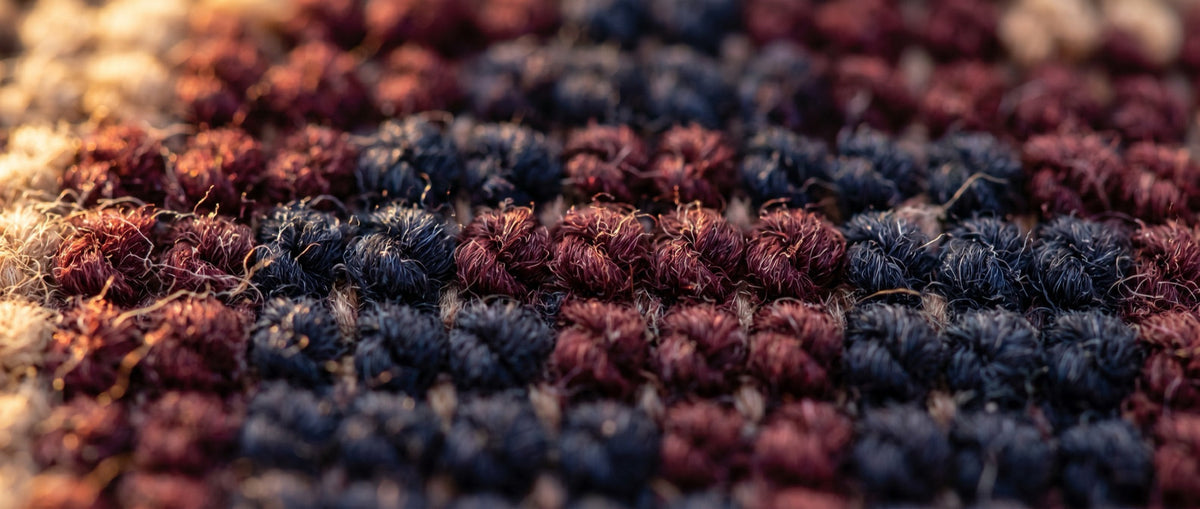
This is where the work happens. The weaver sits in front of the loom and ties one knot at a time, working left to right across each row, then moving up to the next row. Each knot is tied around two adjacent warp threads (Turkish symmetrical knot) or around one warp with a loop under the adjacent (Persian asymmetrical). The yarn is cut after each knot is tied.
A skilled weaver produces 8,000–12,000 knots per day. For a 9x12 rug at 200 KPSI (3.5 million knots), that is 300–440 person-days of knotting alone. After every row of knots, the weaver passes one or two weft threads through the warp and beats them down to compress the knot row. The combs used for this are wooden or metal, made specifically for the loom.
The pattern is read from a designer's cartoon (a graph-paper map) that hangs next to the loom. The most accomplished weavers can work from memory after the first 10% of the pattern. The least experienced rely on the cartoon throughout.
Stage 6: Shearing and finishing (1 week)
When knotting is complete, the pile is sheared to a uniform height. Different traditions specify different pile heights — Oushak is typically 8–12mm, Mamluk is 6–10mm, fine Persian is 4–8mm. The shear is done by hand with specialized scissors; mechanical shearing is faster but produces an inconsistent finish.
After shearing, the rug is removed from the loom, the warp threads are cut to form the fringe (or knotted, depending on tradition), and the selvages are bound. This is the moment the rug becomes a complete object.
Stage 7: Washing (1–2 weeks)
The finished rug is washed. The wash removes residual dye and lanolin, allows the wool to "open" and reveal its full luster, and slightly mellows the colors. Traditional washing is done in clear water with pH-neutral soap, by hand, in batches. The rug is laid flat on stone, washed with brooms or paddles, rinsed multiple times, and dried in sunlight.
The wash takes 1–2 weeks because the drying alone takes 4–7 days for a 9x12 piece. Mechanical washing (drum-washing, chemical rinsing) is faster but harsher; it strips lanolin and removes patina.
Stage 8: Inspection and shipment (1 week)
The finished, washed rug is inspected for any irregularities. Minor corrections — selvage rebinding, fringe trimming, isolated re-knotting — are completed. The rug is photographed in full and in detail, the documentation file is compiled (workshop, weaver, materials, dyes, dimensions, knot count), and the piece is packed for shipping.
Total timeline summary
| Stage | Time |
|---|---|
| Wool selection + washing | 1–2 weeks |
| Hand-spinning | 4–6 weeks (often parallel with other stages) |
| Natural dye batching | 2–3 weeks |
| Warping the loom | 1 week |
| Knotting | 8–10 months |
| Shearing + finishing | 1 week |
| Washing | 1–2 weeks |
| Inspection + shipment | 1 week |
| Total elapsed | 9–12 months for a 9x12 at 200 KPSI |
Why this matters when you buy
This is why a hand-knotted rug from a documented workshop costs $10,000+ for a 9x12 — there is no way to produce it for less without compromising one of the stages. Hand-spun wool, natural dyes, full hand-knotting at the right density, traditional finishing — all of it takes the time it takes. When a rug is priced as if it can be produced for $2,000, one or more stages has been mechanized or skipped.
The pieces we curate at the mid tier and above respect all eight stages. The documentation that comes with each piece lets you see exactly which workshop produced it, when, with what materials. That is what distinguishes a hand-knotted heirloom from a commercial reproduction.
See the process
Our Behind the Loom page documents the workshops we work with and shows pieces at multiple stages of production. For the broader context on hand-knotting techniques, see our weaving techniques guide. To see finished pieces from these workshops, browse our handmade collection, luxury hand-knotted collection, or Oushak collection. From our Boston atelier.
Curating a piece for your room? Request a private selection — our Boston curator will reply within 24 hours with three pieces from current rotation.