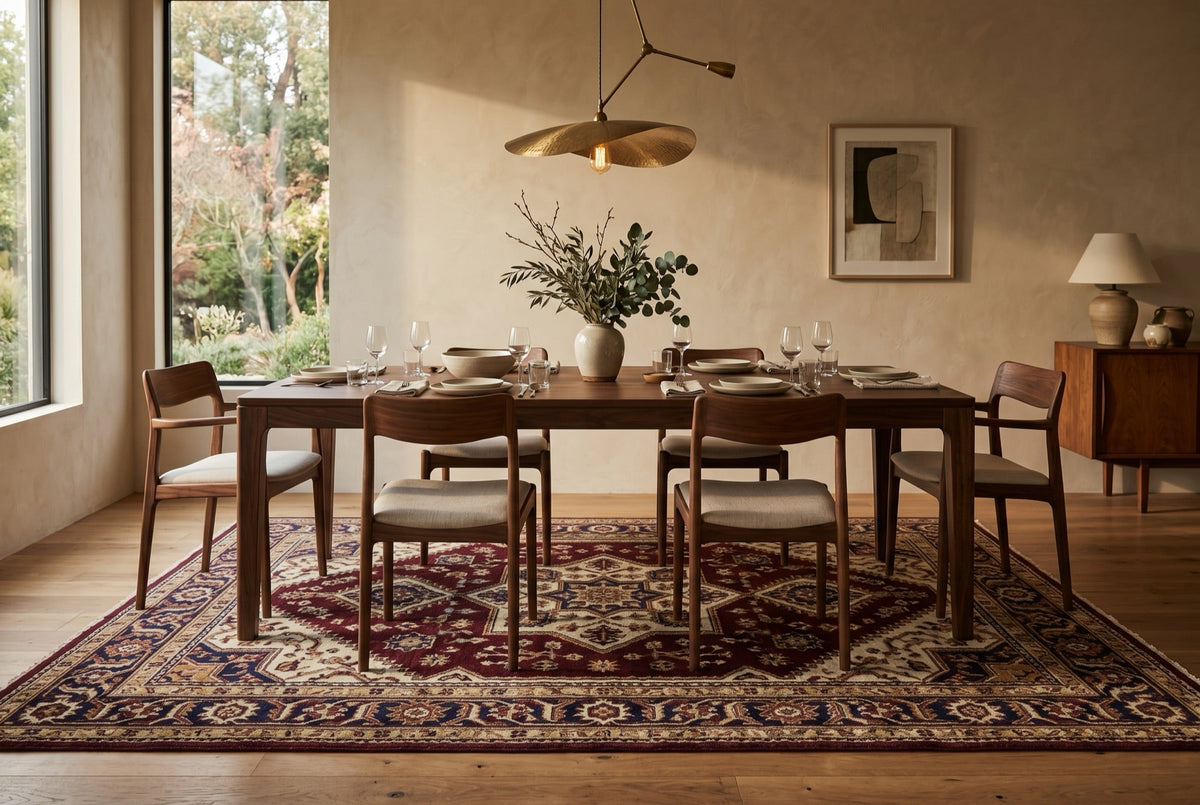
Quick answer: Mamluk rugs originate in 15th-century Cairo, under the Mamluk Sultanate. They are unmistakable for four reasons: concentric medallions (often nested octagons or eight-pointed stars), a restricted palette of roughly seven natural-dyed colors (soft red, deep blue, ivory, gold, green, two browns), extraordinarily fine knotting (200–500 KPSI), and an architectural symmetry rooted in Islamic geometric design.
A Mamluk rug is unmistakable once you have seen one. Concentric medallions enclosed in a geometric repeat field, a palette restricted to roughly seven natural-dyed colors, an extraordinarily fine knot count, and a balance so symmetrical it reads almost mathematical. The Mamluk tradition originates in 15th-century Cairo, under the Mamluk Sultanate, and survives today only because a small number of master weavers preserved the technique through generations of disruption. This guide is what we tell collectors at our Boston atelier who are considering their first Mamluk piece.
Where Mamluk rugs come from
The Mamluk Sultanate ruled Egypt and the Levant from 1250 to 1517. During its later century, Cairo became a center of luxury textile production for the courts and mosques of the Islamic world. Mamluk workshops developed a visual language distinct from contemporaneous Persian or Anatolian weaving — flatter color, denser geometric structure, and a near-architectural symmetry rooted in the same proportional logic as Islamic tile design.
After the Ottoman conquest in 1517, production declined sharply. The pieces that survive from the original Mamluk period are among the most valuable hand-knotted rugs in the world; one example sold at auction in 2014 for $34 million. Original Mamluk pieces now live in museum collections — the Metropolitan Museum of Art, the Museum of Islamic Art in Cairo, the V&A, the Textile Museum in Washington. They are not available to private collectors at any price.
Modern Mamluk rugs — the pieces a contemporary collector can actually buy — are revival weavings; ours are hand-knotted at our workshop in Afghanistan. The best of them are knotted on a wool foundation with hand-spun yarn and dyed exclusively with vegetable extracts. A well-made revival Mamluk is, in our experience, one of the most underrated pieces a serious collector can acquire today.
How to identify a Mamluk rug
Four cues set Mamluk pieces apart from other traditions:
- Concentric medallions. The central medallion is typically composed of three to seven nested geometric shapes — most often octagons or eight-pointed stars. Around this core, a repeating field of smaller geometric motifs extends to the border.
- Restricted palette. Traditional Mamluk pieces use roughly seven colors — a soft red, deep blue, ivory, gold, green, and two browns. The restraint is structural to the aesthetic; a Mamluk piece with twenty colors is almost certainly not a Mamluk.
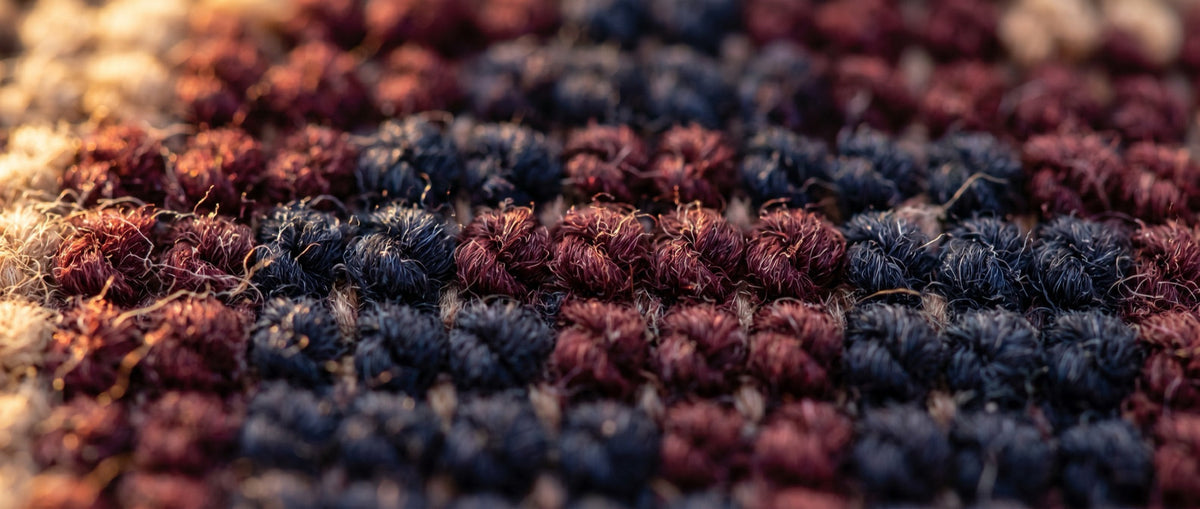
- High knot density. Authentic Mamluks were woven at 300–500 KPSI (knots per square inch). Modern revival pieces typically run 200–400 KPSI. This is dense enough that the pile holds a sculpted, almost beveled surface when viewed at a low angle.
- Architectural symmetry. Mamluk design follows the same proportional rules as Islamic geometric tiling. The field is rigorously balanced; the border repeats with mathematical precision. If a piece feels casual or asymmetric, it is not Mamluk.
What a Mamluk costs
Revival Mamluks at the entry tier — 8x10 or 9x12, ~200 KPSI, vegetable-dyed wool on a wool foundation — typically range from $4,000 to $8,000. Mid-tier pieces (300+ KPSI, hand-spun yarn, longer production timeline) range from $8,000 to $18,000. Master-grade revival pieces (400+ KPSI, silk highlights, larger sizes) can exceed $25,000. Original 15th–16th century Mamluks are not available outside museums.
The price ceiling on a Mamluk is set by the labor: a 9x12 revival Mamluk at 300 KPSI requires roughly 12–15 months of one weaver's life. This is more time than most Persian medallion designs require because the geometric precision allows zero margin for error.
How to live with a Mamluk
Mamluk pieces look almost theatrical in a formal living room or study with neutral walls and antique wood furniture. The geometric symmetry sits well next to architectural plaster, paneling, and stone — anywhere the room itself has formal proportions. They struggle in casual or modern minimalist rooms because the visual density of the field competes with simpler furnishings.
For room placement: a Mamluk wants to be the floor anchor in a room organized around it. Center it in a seating arrangement so the medallion is visible from the primary sightlines. Do not partially cover with furniture if the medallion is the focal point. In a dining room, the medallion is best left fully visible under the table — meaning the rug should be sized so the medallion is bordered by the dining chairs in their seated position rather than covered by them.
How we verify provenance at our Boston atelier
Every Mamluk piece we curate is provenance-reviewed: we trace the workshop, the master weaver, the wool source, and the dye process. Pieces that fail any of these checks are not added to inventory. For a piece in the $10,000+ tier, we provide written provenance documentation that includes weaver attribution, production timeline, and a photographic record of the piece on the loom. This documentation is what makes a Mamluk insurable at full replacement value rather than depreciated retail.
If you are evaluating a Mamluk from another dealer, ask for the same documentation. Reputable dealers can produce it; commercial reproductions cannot.
Mamluk pieces currently in rotation
Our curated Mamluk collection rotates as pieces are sold and replaced. Each piece in the collection is hand-knotted, vegetable-dyed, and provenance-reviewed before it joins the inventory. For collectors considering a first Mamluk, we recommend starting with a 6x9 or 8x10 in the entry-to-mid tier and living with it for a year before committing to a larger or finer piece — the Mamluk aesthetic rewards extended viewing, and a year of daily contact tells you whether you want to go deeper into the tradition.
For background reading on hand-knotted construction generally, see our piece on rug weaving techniques and the Persian regional traditions that share knotting heritage with the Mamluk school. For an overview of how we evaluate any piece before adding it to inventory, see our how to buy a hand-knotted rug reference. From our Boston atelier.
Curating a Mamluk for your room? Request a private selection — our Boston curator will reply within 24 hours with three pieces from current rotation, sized and palette-matched to your space.