Quick answer: Oushak, Persian, and Mamluk are three distinct hand-knotted traditions. Oushak: Anatolian, soft palette (saffron, terracotta, ivory), large botanical medallions, Turkish symmetrical knot, 60–120 KPSI. Persian: Iranian, jewel-tone palette, intricate floral medallions, asymmetrical knot, 100–500 KPSI. Mamluk: Cairene 15th-century origin, seven-color restricted palette, concentric geometric medallions, Persian-influenced knot, 200–500 KPSI.
Oushak, Persian, and Mamluk are three of the most influential hand-knotted traditions in textile history, and once you know what to look for, you can almost always tell them apart at a glance. The differences are in the palette, the motif vocabulary, the knot density, and the originating region. This guide walks you through the visual cues we use in our Boston atelier when we identify a piece — and the most common mistakes new collectors make.
The five-second visual test
Before any technical analysis, train your eye on the overall impression:
- If the rug feels soft, faded, and architectural-looking with large empty space around a medallion and a palette of muted saffron-terracotta-ivory — almost certainly Oushak.
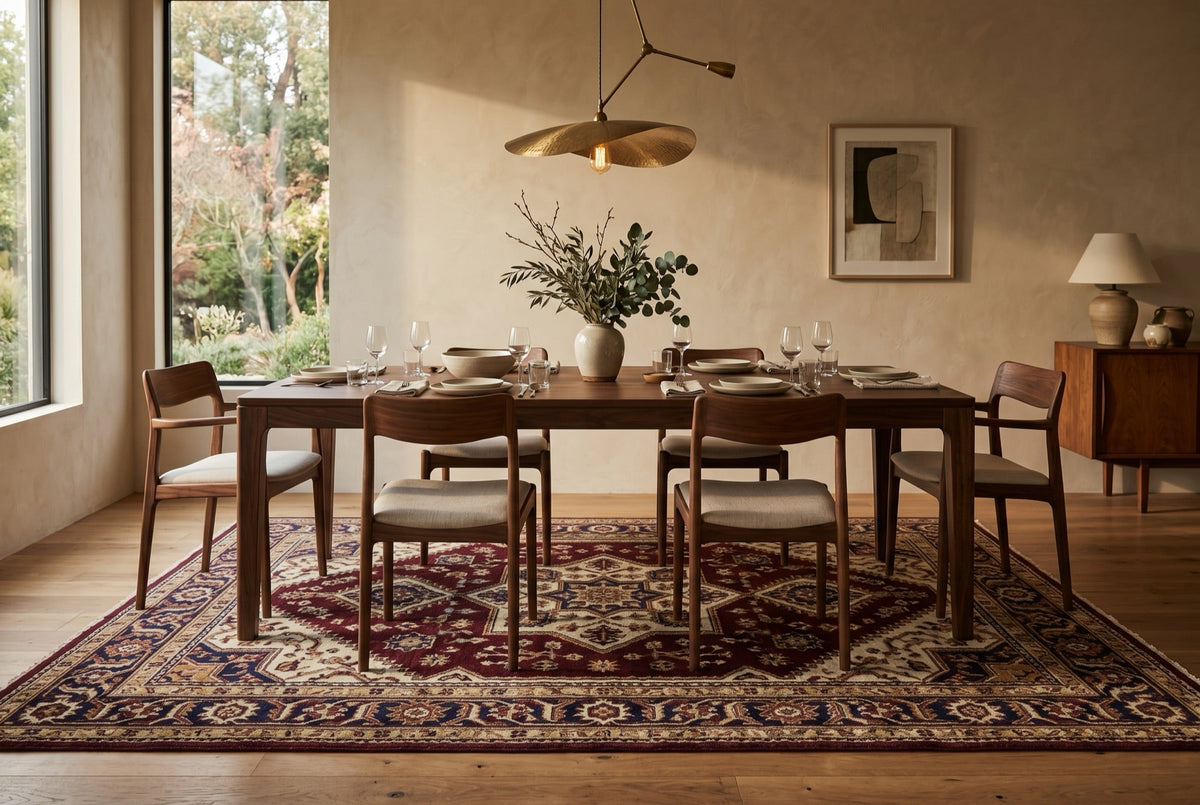
- If the rug feels formal, densely patterned, with deep jewel-tone reds and indigo and curvilinear floral detail filling every inch — almost certainly Persian (specific region requires closer inspection).
- If the rug feels geometric, rigorously symmetrical, with concentric nested medallions and only six or seven colors — almost certainly Mamluk.
That five-second test gets you to the right tradition 80% of the time. The remaining 20% is detail work covered in the rest of this article.
Origin and history
| Tradition | Originating region | Documented from | Cultural context |
|---|---|---|---|
| Oushak | Uşak, western Anatolia (Turkey) | 15th century | Ottoman court production; major European export from 16th century |
| Persian | Iranian plateau (Tabriz, Kashan, Isfahan, Heriz, Qom, Bijar, Nain, Kerman) | Pre-5th century BCE (Pazyryk carpet, 500 BCE, is Persian-tradition) | Safavid dynasty zenith (1501–1736); city workshops + village/tribal |
| Mamluk | Cairo, Egypt | 15th century | Mamluk Sultanate court production; near-extinct after Ottoman conquest 1517; modern revival 20th c. |
Palette
Palette is the single most reliable identifier. The three traditions sit at different points on the color wheel and use different total ranges.
- Oushak palette: soft saffron, terracotta, ivory, pale blue, sage. Total range of 5–8 colors. Low contrast between any two adjacent colors. Reads sun-faded even when new.
- Persian palette: deep madder red, indigo blue, ivory, gold, green, sometimes black. Higher contrast. Reads saturated, jewel-toned. Range varies by region — Kashan and Tabriz lean red-and-blue; Nain leans ivory-and-blue; Isfahan leans rose-and-ivory.
- Mamluk palette: seven colors, strictly. Soft red, deep blue, ivory, gold, green, two browns. The restraint is structural — a piece with twenty colors is not Mamluk.
Motif vocabulary
The decorative grammar of each tradition is distinct.
- Oushak motifs: large-scale medallions (often star-burst or stepped diamond), open field with spacious botanical fills (vines, palmettes, stylized leaves), arabesque borders, low-density compositions with room to breathe.
- Persian motifs: central medallion with corner spandrels, dense floral fields (herati, boteh, shah-abbas palmettes), multi-band borders (often three or more), curvilinear vine work. Region-specific signatures: Tabriz uses herati fish-and-diamond; Kashan uses formal florals; Heriz uses bold geometric medallions; Qom uses garden-panel motifs.
- Mamluk motifs: concentric medallions (nested octagons, eight-pointed stars) with rigorous geometric repeat field of smaller geometric units, architectural border. Almost no curvilinear motif. Reads more like Islamic tile design than like floral.
Knot density and construction
| Tradition | Knot type | Typical KPSI | Foundation |
|---|---|---|---|
| Oushak | Turkish (symmetrical) | 60–120 | Cotton or wool |
| Persian (city) | Persian (asymmetrical) | 200–500+ | Cotton or silk |
| Persian (village/tribal) | Persian or Turkish | 60–150 | Wool or cotton |
| Mamluk (revival) | Persian (asymmetrical) typically | 200–400 | Wool or cotton |
The lower-KPSI Oushak is not a quality concession — the coarser knot is part of the aesthetic, producing the soft, drapey hand that distinguishes Oushak from rigid Persian construction. KPSI in Oushak reflects tradition, not corner-cutting.
The hand test
Turn the rug over and feel the back. The three traditions have distinct hand qualities:
- Oushak back: supple, drapes easily, you can fold the corner without resistance. Coarser knot pattern visible on the reverse.
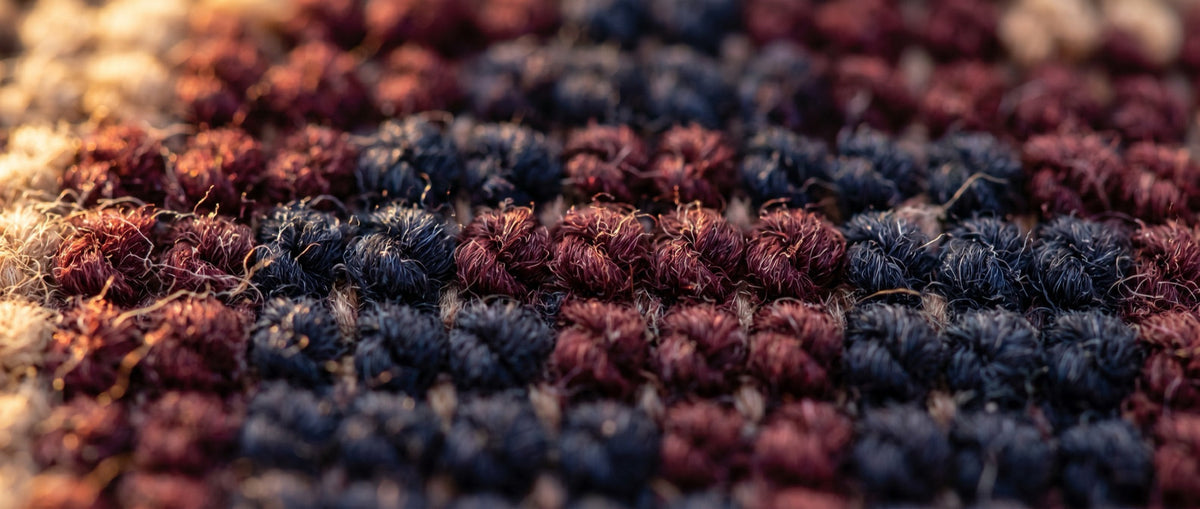
- Persian back: firmer, denser, less drape. The knot pattern reads as a finely textured grid.
- Mamluk back: firm and even but with the architectural geometry visible in the knot pattern itself — the back almost looks like a low-relief tile.
Common misidentifications
- Modern Indian production sold as Persian. Indian-knotted pieces using Persian designs are widespread. The construction is Persian-influenced but the wool, dye, and provenance are not Iranian. Reputable dealers disclose this; commercial sellers often do not.
- Pakistani Bokhara sold as Persian Bokhara. Pakistani-woven Bokharas use the elephant-foot motif of Turkmen tribal weaving but are not Persian. Not lower quality necessarily, but different attribution.
- "Oushak-style" sold as Oushak. Contemporary mass-production from Turkey, Pakistan, and India makes Oushak-inspired pieces with synthetic dye and machine-spun wool. These are not the same as traditional Oushak weaving in the Uşak tradition.
- Reproduction Mamluk sold as Mamluk antique. Original Mamluk pieces are in museum collections. Any "Mamluk" on the market is a revival weaving — usually 20th or 21st century. This is fine as long as it is disclosed.
Where to see each tradition
Our Oushak collection, Persian collection, and Mamluk collection rotate as pieces are sold. Each piece is provenance-reviewed with workshop attribution and weaver name (where available). For deeper reading on each tradition individually, see our Oushak history, Persian regional traditions, and Mamluk pillar pieces. For background on the knotting techniques compared above, see rug weaving techniques. From our Boston atelier.
Considering pieces from one of these traditions? Request a private selection — our Boston curator will reply within 24 hours with three pieces matched to your room.